For the past year or so, I’ve been learning Greek through a couple of apps on my phone. Why Greek? For one, part of my DNA is actually from that region of the world – through my father and his mother. Two, I’ve always loved etymology and it’s actually one of the tools we use in a Montessori classroom when teaching new words, and Greek is one of the main influences for the French language. Three, I’ve always felt a bit lacking in my language skills. Sure, I speak/write in French and English and understand Lebanese Arabic to a certain extent, but I’m nowhere near my siblings in that department, one of whom actually speaks five different languages. Granted, it’s not a very useful language in everyday life here in Quebec, but I still find it incredibly rewarding and intellectually stimulating.
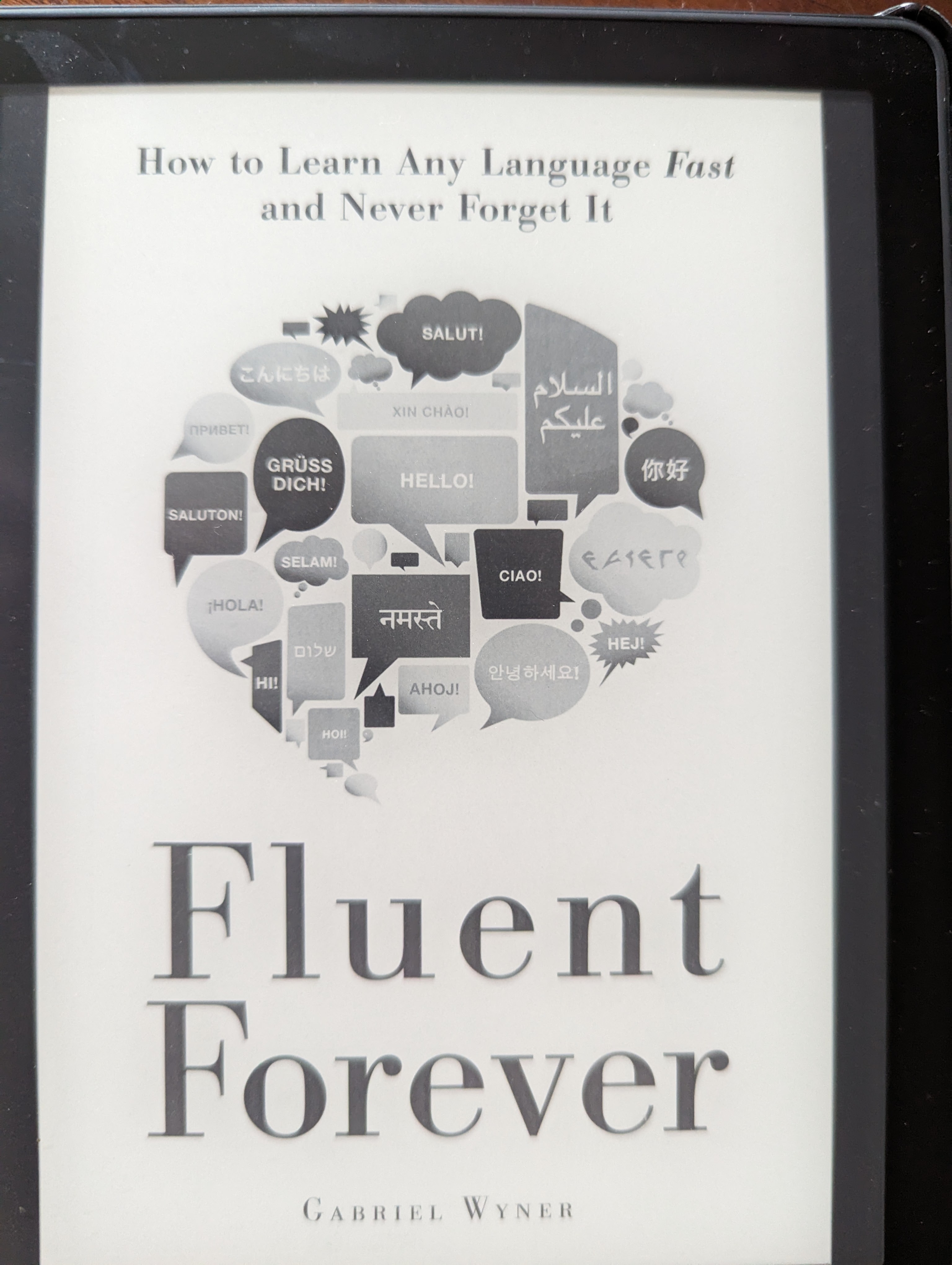
Enter this book, written by an opera singer who has had to learn multiple languages for his day job. Through his numerous experiences, he’s acquired quite a bit of knowledge regarding languages and techniques to learn them efficiently. His approach is really hands-on, not only giving the ideas, but concrete tools to put them in place. There are quite a few of them I found illuminating.
For example, he highly recommends the use of flash cards, which in itself isn’t a novel idea. But he goes much farther and explains into minute details how to prepare them – how to choose the right words or phrases as well as significant images to accompany them – so they’re as efficient as possible and how to integrate them in your practice session. He also goes into details about which other materials you might need, like books or dictionaries (bilingual or not), websites or applications and how to use them to become better, faster.
Another interesting chapter is about pronunciation, which for him is key when learning a new language. Anyone who’s ever learned a new language as an adult knows how some sounds can be hard to replicate if they’re not part of your mother tongue. Even more so when there any many variations of the “same” sound, like some languages have multiples sounds between d and t, often changing the meaning of a word if you don’t get it right. He talks about the phonetic alphabet and how useful it can be when incorporating sounds from other languages. One example I loved as a French speaker is how he explained our “u” sound, as in “cru”, which for English speakers isn’t usual at all. The way we place different parts of our mouths to make sounds is so automatic we don’t stop and think about it. Ever. It reminded me of my Montessori training where I spent a couple of hours one evening trying to figure out exactly what am I doing with my mouth to produce every sound we use in French : where the tongue is, whether lips touch or not, which path does the air take, etc.
As I’m learning Greek and slowly discovering the intricacies of that particular language, the chapter on how they are structured really spoke to me. I’ve come to learn most of the subtle differences between French and English, but even now I make mistakes a native speaker will undoubtedly notice. The authors compares it to learning algebra, where you have to put different items in the right order for them to make sense. For example, in French you might say “Il leur achète des fleurs” (He them buys flowers), whereas in English it would be “He buys them flowers”. The pronoun “leur” or “them”, the persons for whom the flowers are bought, is placed between the subject and the verb in French and after the verb in English. It’s subtle, and it’s something you can only learn by sheer repetition (reading, writing, listening).
It’s a captivating read and a well-made guide for anyone who wants to start to learn a new language from scratch (or not). I plan on coming back to it a couple of times to try and incorporate some of his ideas into my own practice.
 I Read Many Things
One response to “Fluent Forever : How to Learn any Language Fast and Never Forget It, by Gabriel Wyner”
Encourageant comme livre. Faute de pratique, j’ai oublié très rapidement les mots en arabe, hébreux et espagnol que je m’étais efforcé d’apprendre pour mes voyages.
LikeLike