
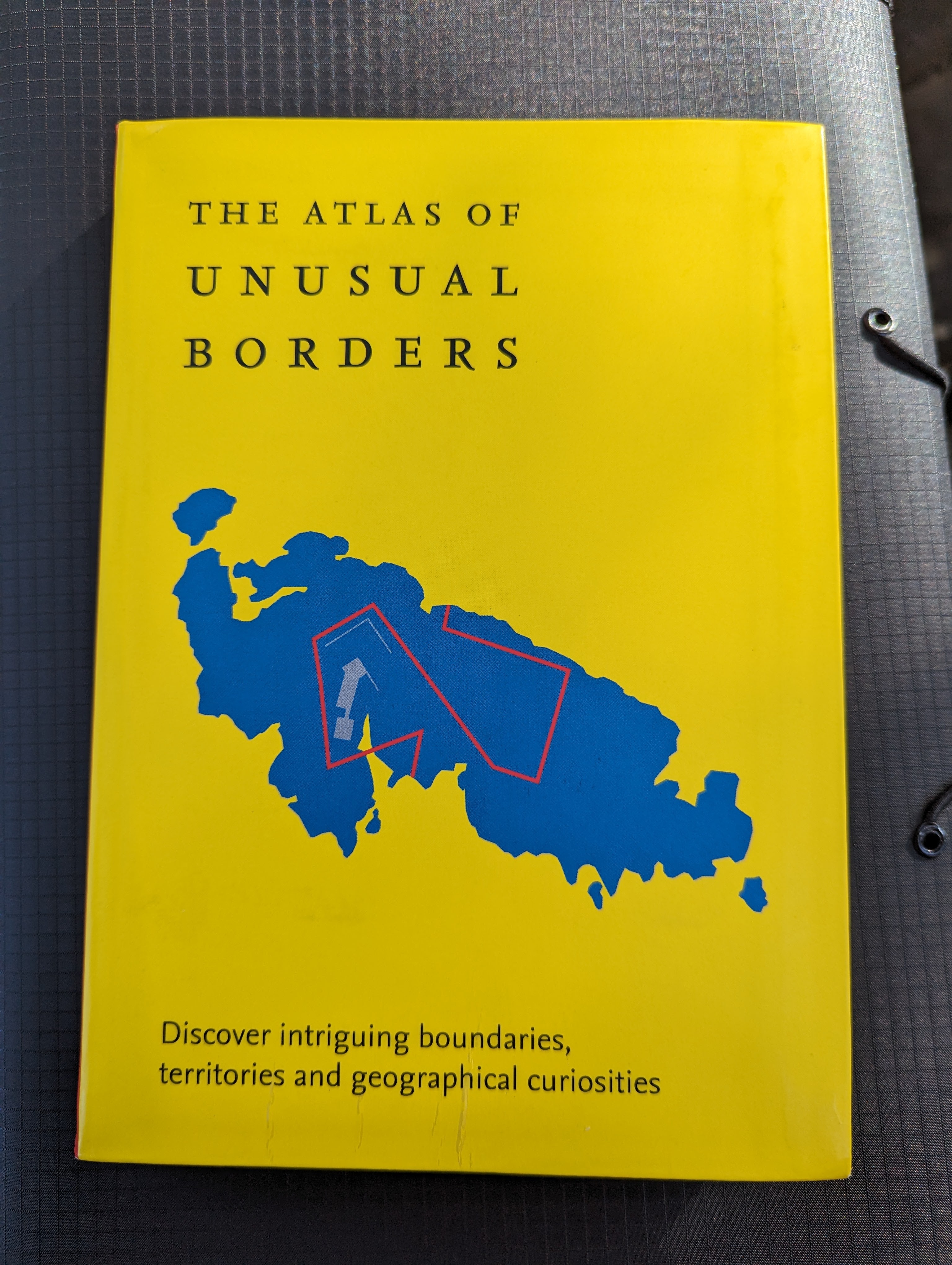
Here’s a book I bought almost exclusively for its title. Even as a kid, I loved atlases and maps. I remember having this big world map above my bed with facts for each countries like population, area, currency and other facts. I remember buying that old (even at the time) big red atlas in a thrift shop. It was the mid-90s, so I was maybe around eight, and the atlas was from 1969. It had the USSR and other political entities I was not familiar with. In any case, atlases and maps were a part of my life for as long as I can remember.
This is why the title was so interesting to me. I have also watched a few videos on YouTube on strange borders by creators such as Jay Foreman and RealLifeLore (go visit them, they’re pretty good!).
Country borders are a deeply human concept and have their roots in history, either political, economical or cultural. That’s the aim of this book, to present the unusual borders and explain, in a few hundred words, their history and how they came to be. In some cases, the author also explains how they’re managed today on a daily basis. It’s bite-size information, a border or set of borders is presented on a map, then explained or summarised in the following one to four pages. They are grouped in different “types” of borders that make up the sections of the book.
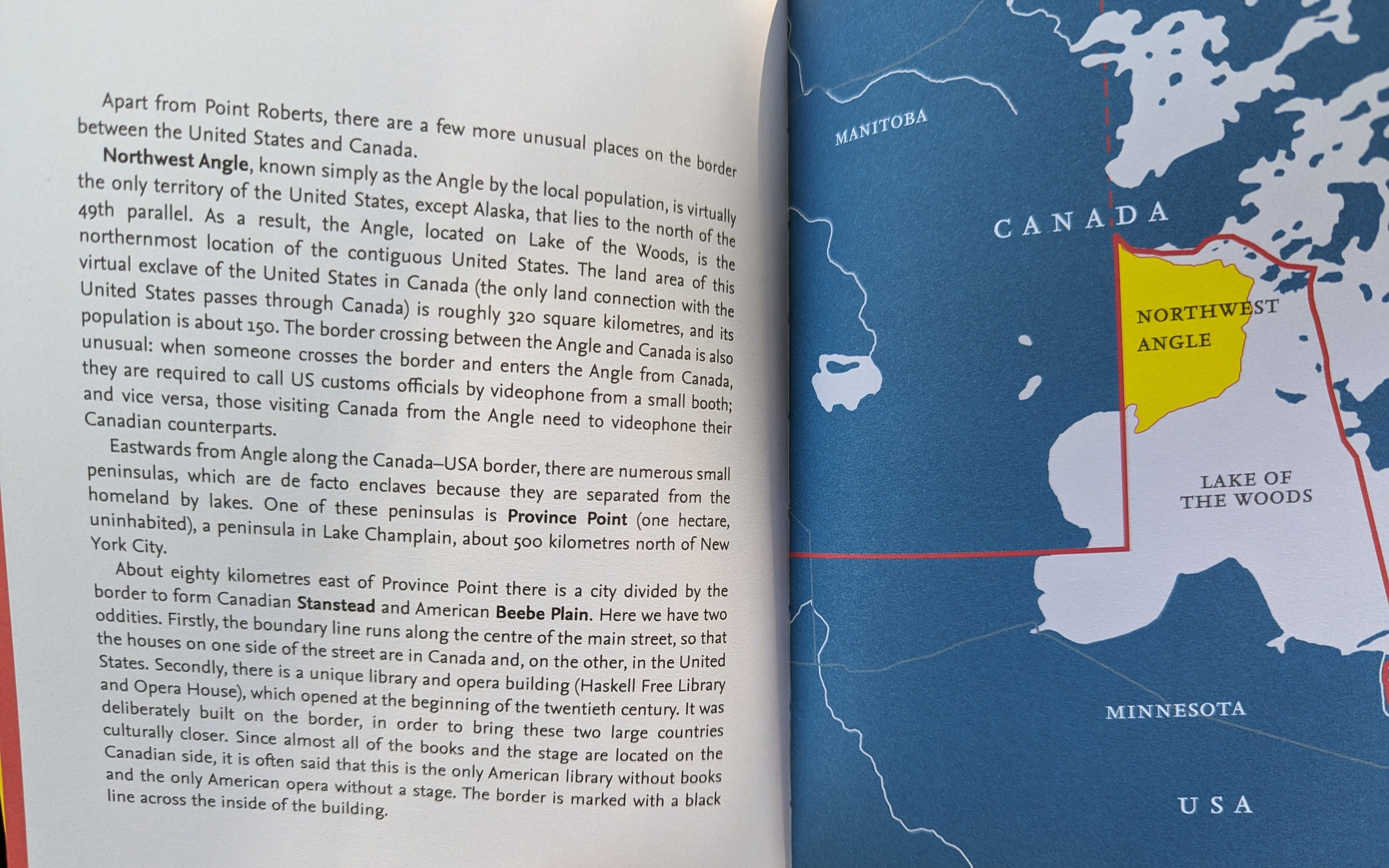
First there are the enclaves, the parts of a country that are fully inside another country, often with no way to get out without crossing an international border. Some of them are pretty crazy, like this one city where some houses are part of a country or the other depending on their orientation.
Another section is on joint sovereignty of a land, often an island. There’s this island between Spain and France that actually switches hands every six months. For the past 350 years, meaning that this little island has changed allegiance seven hundred times already.
There’s a bit on the junctions of multiple countries, or smaller political entities like states or even municipalities. There’s actually one such quadripoint here in Canada between Manitoba, Saskatchewan, the Northwest Territories and Nunavut. According to the book, Mount Etna in Italy is the meeting point of eleven municipalities! Now you can be as fun at parties as I am.
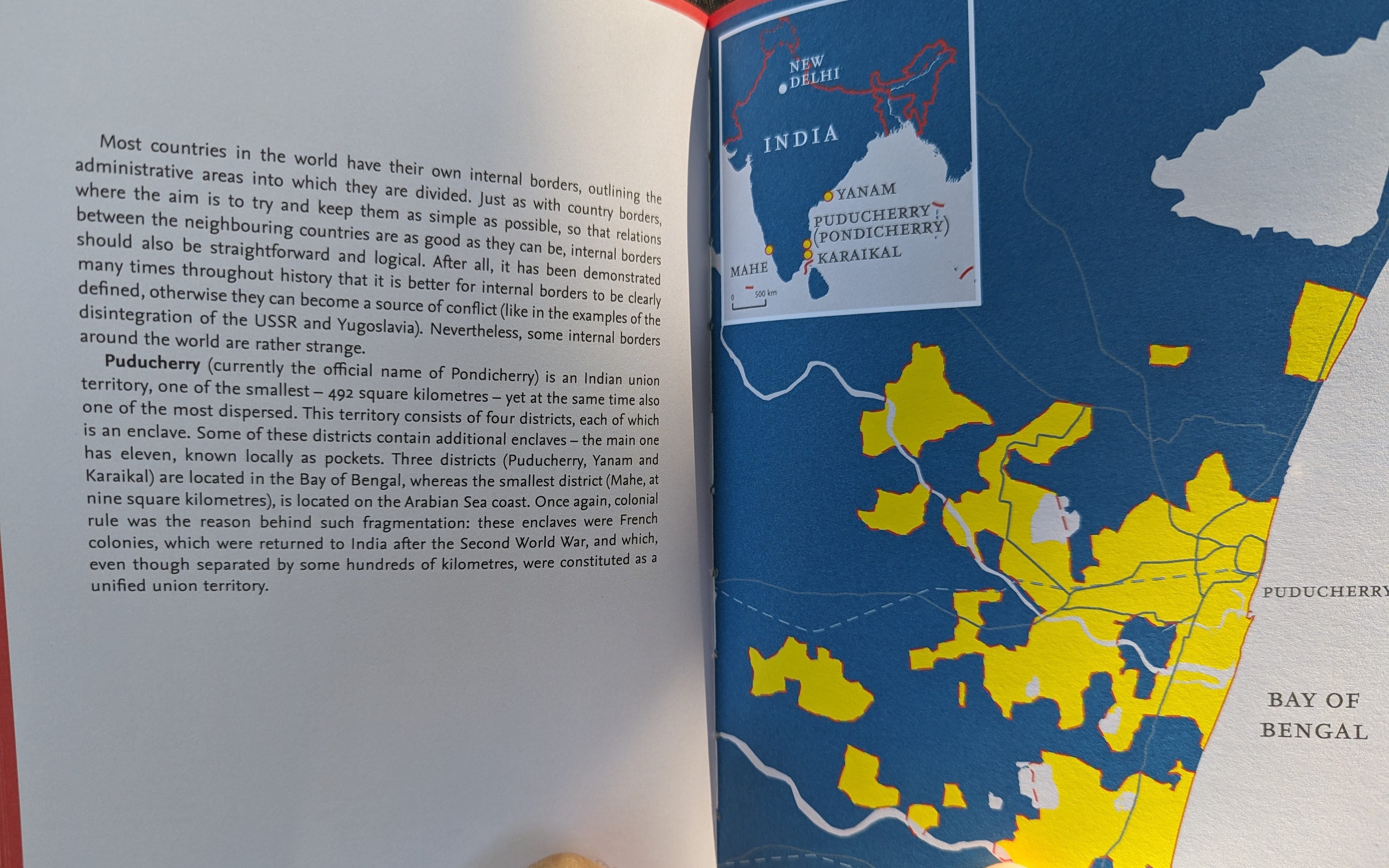
There are loads of other examples of various border shenanigans from across the world. A city that is the capital of two regions but is actually in neither. Another city that has been wiped out by a volcano but that has retained its status as a capital of the country even if it’s a ghost town. A great river that doubles as a border between two continents. Cities that have grown across borders with inhabitants living in two time zones.
I enjoyed this read for the most part, but unless you already have an interest in geography and/or world politics, this book is nothing more than a series of fun facts. And let’s be honest, when we look at fun facts about something outside our fields of interest, we might remember one or two of them at most. I know I’ll likely come back to it a few times to remind myself of a few of the weirder examples, but I’m in the minority.
(En français, ce livre s’intitule L’Atlas des Frontières Insolites)
 I Read Many Things
One response to “The Atlas of Unusual Borders, by Zoran Nikolic”
J’adore!
LikeLike