Like many, I’ve been dealing with some form of eco-anxiety for the past few years. Not surprising, since we’re constantly bombarded with apocalyptic news about the state of the environment, whether it’s global warming, deforestation, mass extinction of species or any other similar subject. Usually, any book that dabbles in these issues can be hard to read, making me feel sad and powerless.
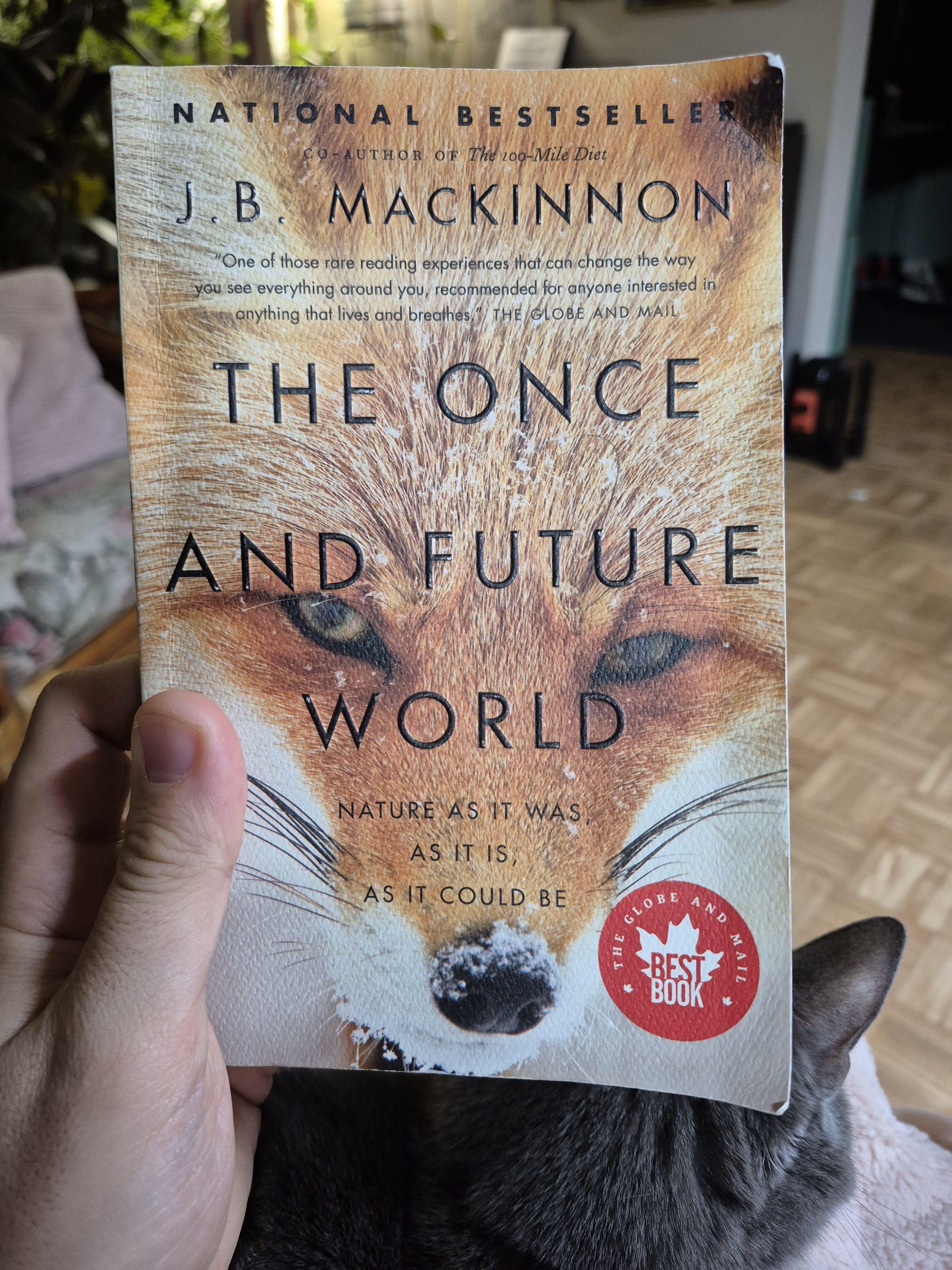
J.B. Mackinnon’s book takes a different approach. It’s a book about our relationship to the natural world and how it has evolved over time. Most modern humans living in cities, including myself, have little to no contact with nature. Our understanding is almost all academic, limited to books or documentaries about the subject.
The crisis in the natural world is one of awareness as much as any other cause. As a global majority has moved into cities, a feedback loop is increasingly clear. In the city, we tend not to pay much attention to nature; for most of us, familiarity with corporate logos and celebrity news really is of more practical day-to-day use than a knowledge of local birds and edible wild plants.* With nature out of focus, it becomes easier to overlook its decline. Then, as the richness and abundance of other species fade from land and sea, nature as a whole becomes less interesting—making it even less likely we will pay attention to it.
Starting from that premise, the author explains how and why our relationship with nature has degraded over time. It goes beyond the usually mentioned factors, like shortsightedness and greed. From an environmental standpoint, changes happen over long periods of time, usually much longer than the average lifespan of a human. The baseline of what is considered “normal” keeps moving with each generation, and we have very little idea of what “normal” was fifty or a hundred years ago. Much less hundreds of years ago. Furthermore, we don’t know exactly what would be the ideal balance between man and nature, so that both can thrive.
In fact, that last sentence is a sign that our perception of nature is skewed. We often see it as separate from humans, whereas our relationship would be much richer if it was symbiotic. This divorce between the two has led to most of our negative impacts on the environment. People usually don’t go out of their way to harm the forests, the oceans or the animals. Quite often, the real consequences are not readily apparent, and we are slow to react.
So while the author points out where we have done wrong, he presents various options of what can be done now and for future generations. How we can mend our relationship with nature. In that way, it’s a hopeful book. Not in an overly optimistic and unrealistic way – a lot of damage was done, and large parts of it are irreversible – but in a sensible and feasible way. That’s the true strength of the book.
If you’ve ever had any negative thoughts regarding the state of our relationship with the natural world – and really, who hasn’t? – I can’t recommend it enough.
 I Read Many Things