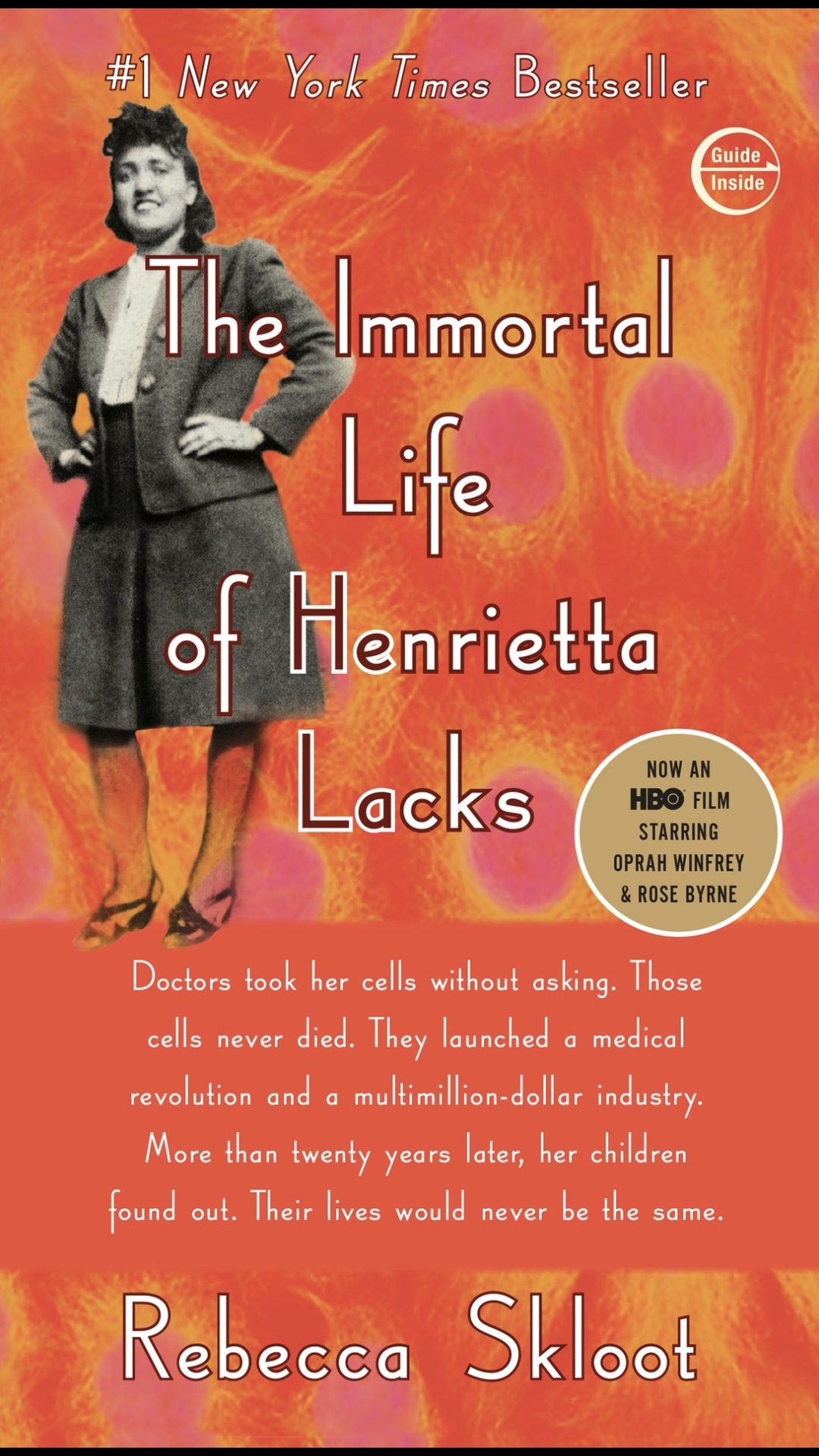
While browsing on various reading forums to get new ideas for future reads, I often came across mentions of this book. Finding the title intriguing by itself, I looked it up online and learned that it was about some extremely resilient cancer cells – called HeLa, for Henrietta Lacks – able to reproduce at a very rapid rate, and were therefore very useful in terms of medical studies. Basically, I was expecting a book about what made these cells so special and how they were used by medical science over the past few decades. While such a book would have been very interesting, it turned out to be much more than that.
Obviously, because part of the book is indeed focused on those cells and their various uses. However, it’s a tiny part of the whole story of Henrietta Lacks. Appreciating the complexities of Henrietta Lacks’ story requires a much wider angle, and that’s exactly what the author is offering.
Spanning decades, from the 1920 to the 2000s, Rebecca Skloot gives HeLa’s story the context it needs. At the time when Henrietta was diagnosed with cervical cancer, the black community of Baltimore (and in the United States as a whole) was already looking at the medical establishment with a lot of distrust, due to many well-documented events, some of which are summarily explained in the book. Plus, Henrietta’s cells were taken without her or her family’s consent or, indeed, without their knowledge. You can definitely understand the resentment from the family towards the medical establishment. In fact, many chapters of the book revolve around the challenge the author faced to get ahold of family members and talk about their deceased relative. During that era, the medical community was also buzzing with the seemingly infinite possibilities of genetic research and all its discoveries, leading many to believe that immortality was a possibility in the near future.
All of this makes for a very compelling story, and since chapters are relatively short (ten pages or fewer), the reader jumps around the timeline and can easily link together the different events and the various actors. It could have been very confusing, jumping from era to era like this, but the author makes it work, weaving timelines seamlessly. It’s quite the feat.
I highly recommend it. It touches on so many aspects – medicine, race, death, science, family, among others – that it’s bound to grab your interest one way or another. As it should. It’s a fascinating, and profoundly human, story.
 I Read Many Things