One of the most vivid childhood memories I have revolves around death. Not the death of a loved one or a pet or anything dramatic. One day, at 8 years of age, I simply became aware of the concept of death. I won’t go into the details, but I can tell you it was extremely distressing. Like most, I could not wrap my head around the idea of “not existing” and didn’t want to accept that possibility. I wrestled with that concept for a while, and it kept me awake at night more than a few times. Sometimes, this anxiety surrounding death morphed into a fear of aging or, more importantly, a fear that one day my parents (and other family members) will also become old and die.
I wish I could say today that I’m totally over it, that I’ve completely accepted getting old and one day dying. I might get to that point eventually. I can definitely say that getting older, becoming a dad myself and seeing my father’s health decline, has shifted my perspective about death and, invariably, about life.
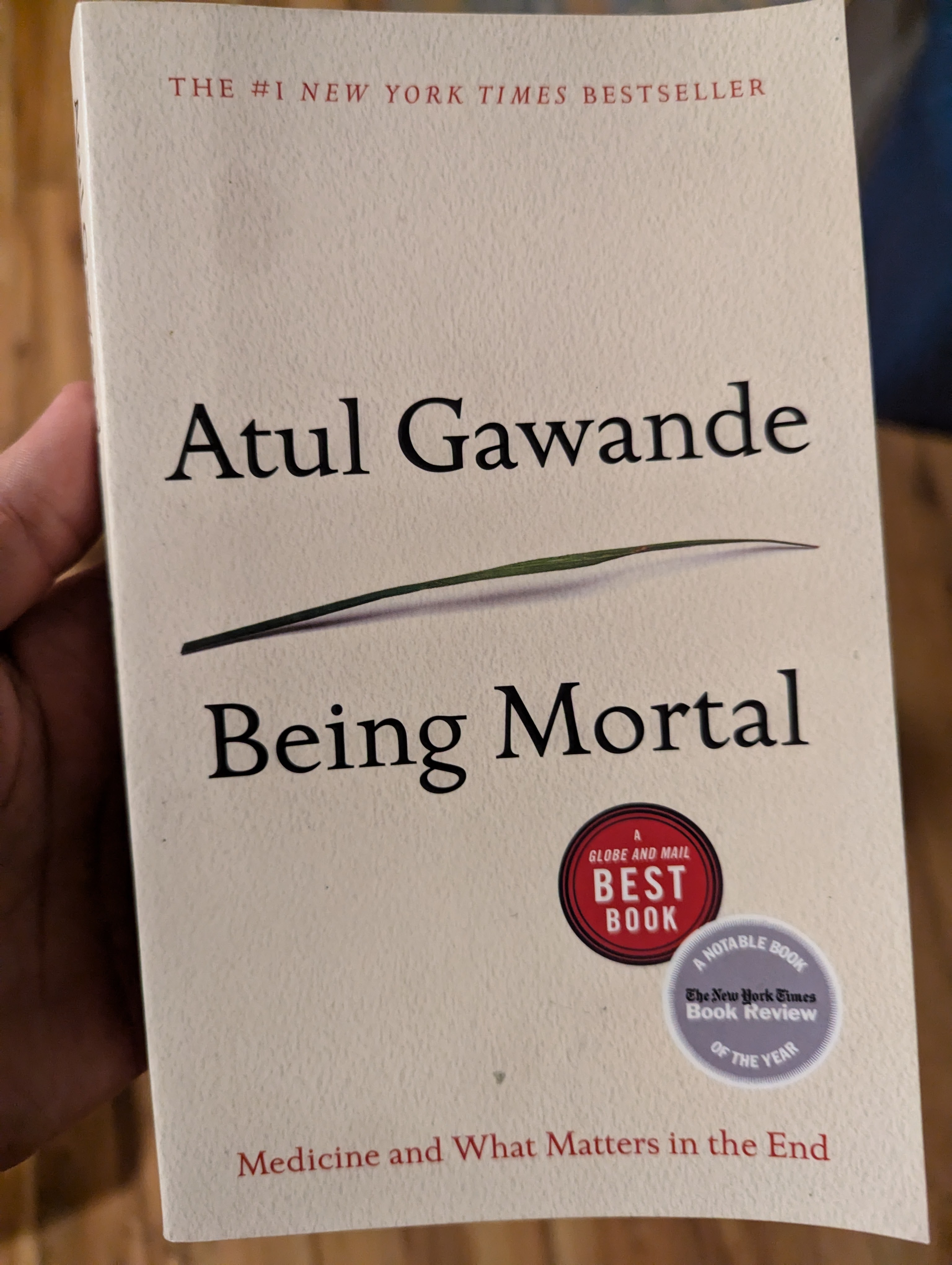
This is where Being Mortal comes in. It would be reductive to say that it’s simply a book about death because it’s so much more than that. While death is a reality we’re all aware of on an intellectual level – for doctors and nurses, on a medical level – its complexities go well beyond that.
From his vast professional and personal experience, the author first takes a look at the oft-ignored reality of getting old and witnessing our own bodies reach their limits and slowly fail and/or fall apart. With medical science progress, the time between the first unequivocal signs of aging (illnesses or various physical and mental ailments) has lengthened significantly. While people live longer, they all hit a wall and it’s a steady slope down from that point on. It’s a series of losses, big and small. Accepting that is not a given for everyone.
It is not death that the very old tell me they fear. It is what happens short of death—losing their hearing, their memory, their best friends, their way of life. As Felix put it to me, “Old age is a continuous series of losses.” Philip Roth put it more bitterly in his novel Everyman: “Old age is not a battle. Old age is a massacre.”
Then there are a few chapters on the various ways society is now dealing with old age and the accompanying illnesses. Nursing homes, hospice cares, hospitals, retirement homes, they all have a part to play and their roles are getting redefined as we learn more and more about what exactly are the needs of the elderly as various stages of their lives. It’s much more complex than I realize and it’s astonishing how much better things can be for everyone involved if the right choices are made.
People with serious illness have priorities besides simply prolonging their lives. Surveys find that their top concerns include avoiding suffering, strengthening relationships with family and friends, being mentally aware, not being a burden on others, and achieving a sense that their life is complete. Our system of technological medical care has utterly failed to meet these needs, and the cost of this failure is measured in far more than dollars. The hard question we face, then, is not how we can afford this system’s expense. It is how we can build a health-care system that will actually help dying patients achieve what’s most important to them at the end of their lives.
The last half of the book is all about the challenges of dealing with death for the people directly involved. It’s tough to read at times. The subject matter is heavy and the conversations between family members can be heart-wrenching. The author spends quite some time describing how degrading health and looming death has affected him on a personal level during his father’s last years. At the same time, he shows how important these conversations and the subsequent decisions are. It’s a fine line to walk, and the author does it perfectly.
It’s certainly not an easy book to read, but I feel like it’s an absolute essential for anyone who will ever have to deal with mortality in any way, shape of form. So, in other words, everyone. While my description of the book might have made it look like a sad or bleak read, it most definitely is not. It’s a remarkably human and genuine approach to a difficult subject. I’m very glad I read it and I plan on coming back to it more than once as time continues to do its work.
Being mortal is about the struggle to cope with the constraints of our biology, with the limits set by genes and cells and flesh and bone. Medical science has given us remarkable power to push against these limits, and the potential value of this power was a central reason I became a doctor. But again and again, I have seen the damage we in medicine do when we fail to acknowledge that such power is finite and always will be. We’ve been wrong about what our job is in medicine. We think our job is to ensure health and survival. But really it is larger than that. It is to enable well-being. And well-being is about the reasons one wishes to be alive.
 I Read Many Things