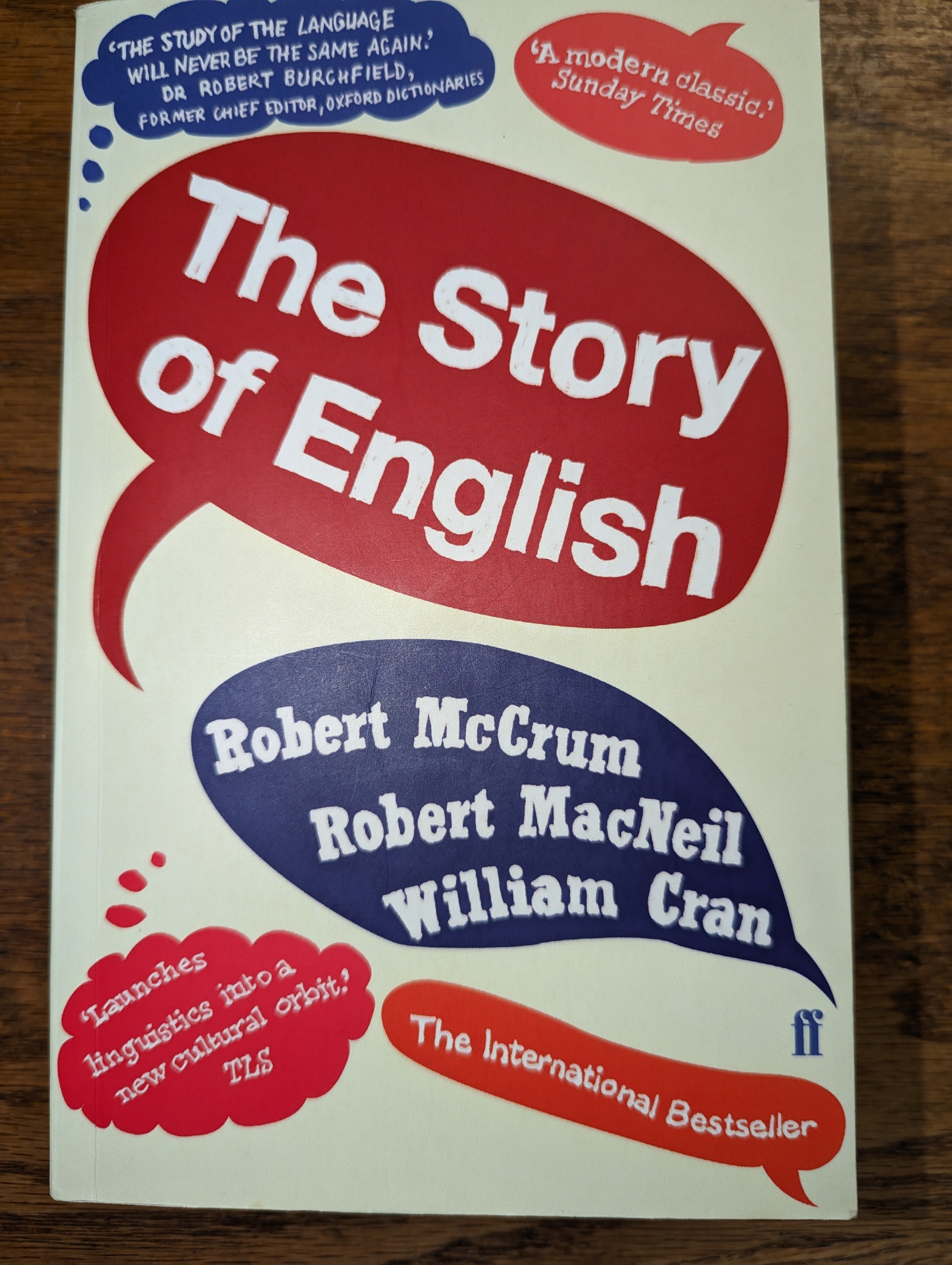
All languages are fascinating. That much is quite obvious for anyone who has ever stopped and thought about it for a second. With a relatively small quantity of sounds – 44 in English, 36 in French – or small curvy lines on a piece of paper (or screen, in this case), we can communicate anything. English, as the most spoken and widely used language in the world, is a special kind of fascinating. For so many reasons that are made clear in this book, it has had an evolution like no other in human history.
The authors first tackle on this massive subject from a historical perspective. Starting with the origins in the Middle Ages, where English was absolutely not a unified tongue but a wide variety of dialects influenced from different cultures and peoples from across Europe (Norse, Celtic, Latin, among others). Eventually it settled into a more coherent whole during the late Middle-Ages and through the Renaissance. During this mostly historical part of the book, we take a look at some of biggest contributors to the English language, Shakespeare, Chaucer and the King James Bible, among others.
Then, now that English has taken a mostly stable form, we take a look at the different ways the language has evolved in certain circumstances. In the UK, they take a look at Irish-Gaelic, Scottish-Gaelic and Welsh. In North America, the focus is on the evolution of Black English and its roots in slavery. Then, going all around the world, we see how English has permeated different countries and has been established as the second language and, in certain cases where there are many different cultures and tongues living within the same borders, as the unifying language.
The book itself was first released in the 1980s and can therefore feel a bit dated in certain spots. For example, the authors were talking about the slow death of some languages due to the rise of English, like Irish Gaelic. However, since the book was released, it has seen quite a resurgence for various reasons. Also, the Internet was barely a concept at the time, and I’m sure the chapters about the future of English would have been even more convinced about its worldwide appeal and growth then they were at the time.
English is extremely free-flowing, it moves around quite a lot and its rules can be bent much more easily than French, my native tongue. It doesn’t have any central governing body like the “Académie Française” we French speakers have. It evolves organically, on a local and international scale.
The book does a good job of representing this idea. Some chapters were not as interesting, but I enjoyed most of them. I especially appreciated the numerous examples they were giving, along with the pronunciation and the origins. I was honestly baffled at how immense a role Shakespeare and Chaucer played in English, inventing new words by the hundreds, if not thousands. To me, the very idea of someone “inventing” words seems a bit alien, as if you were doing something that is not allowed and breaking the rules. But for English, that seems to work.
It’s a niche subject, the story of a language, but if you’re remotely interested in English as a language, it’s worth a read.
 I Read Many Things