
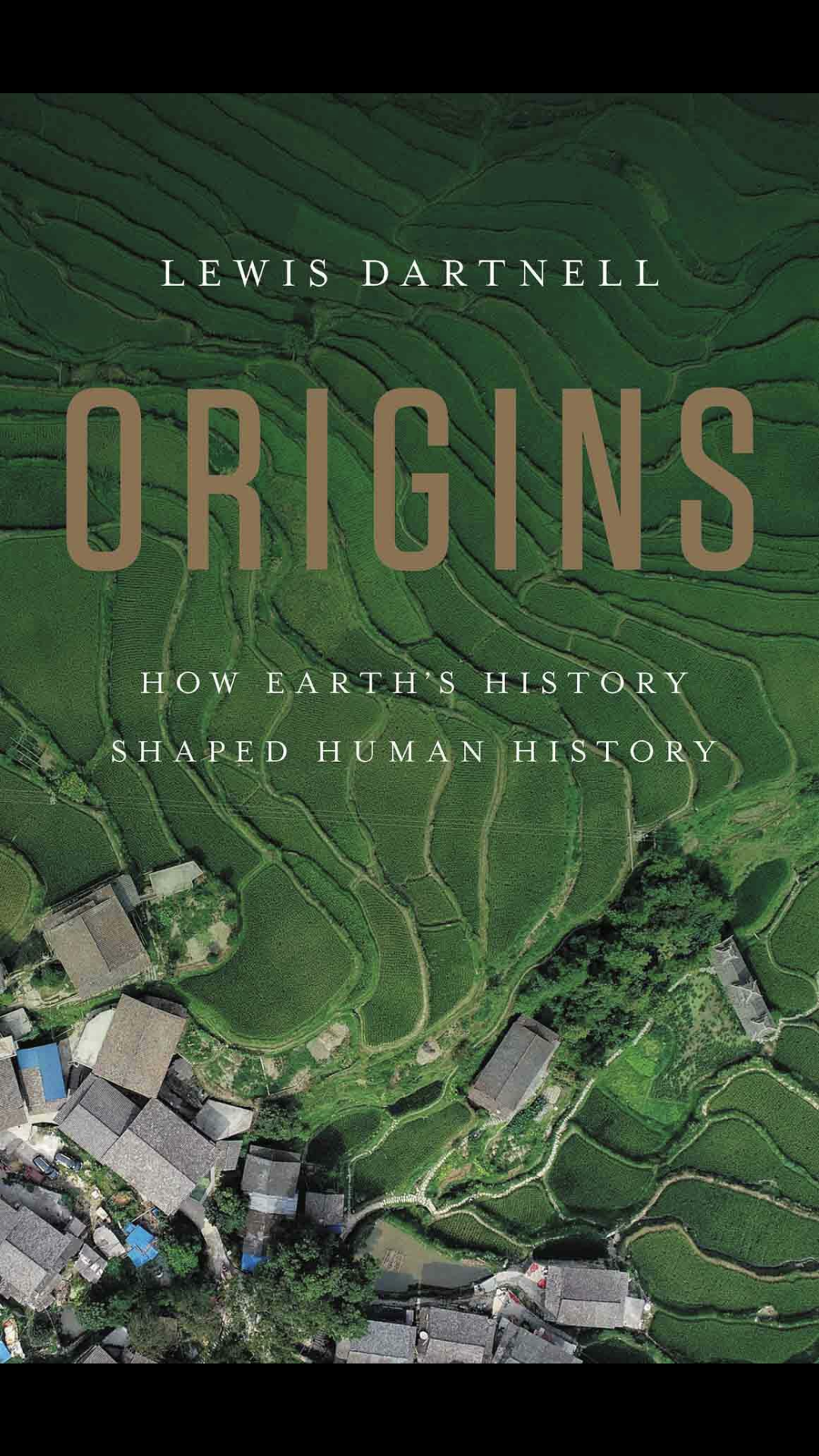
It’s easy to look at the title of that book and think “Well that seems like a rather obvious statement of fact” and go on your way. In some respect, it is. No sane person will disagree that our planet and its physical characteristics have influenced humans in many ways. A quick look at a population density map will show very distinct patterns (people tend to live close to water and not across huge mountain ranges, for example). This book goes much, much further in its analysis.
At first, the author takes the largest possible view, seeing how the natural cycles (the precession of Earth’s axis, ice ages, the movement of plate tectonics, etc.) of our planet have created the conditions in which humans are now thriving. Even since humans came around – a very short time in geological terms – the climate has shifted between ice ages and relatively warm periods. This section of the book makes you appreciate how today’s conditions are actually as optimal as you can hope for as far humans are concerned.
After this opening chapter setting up (quite literally) the conditions we have right now, the author takes a look at important events or eras in human history, then explains them through the lens of geography. Subjects like agriculture, the bronze age or the industrial revolution are all analyzed that way. I’ll point out a couple of chapters I particularly enjoyed to give you an idea of what this whole book is about.
One chapter is all about the age of exploration, where Europeans took to the seas and extended their reach far beyond what anyone expected. The geographical realities making this possible are much more complex than most people realize. To summarize, heated air goes up, then comes down when cooled. This rather simple cycle forms what we call “cells” that are always active and moving air around from north to south or vice versa. To be exact, they would be if the Earth wasn’t rotating. This planetary movement makes these cells shift east or west (depending where you are on Earth) in a very reliable manner. This is, very basically, where global wind currents come from.
Another chapter I really enjoyed was about empires. Not because empires are particularly interesting, but because of how they usually spread, especially in Eurasia. Eurasia is an enormous continent, by far the largest on Earth, and has been the center stage for most of the largest empires in human history. This is due to multiple factors, especially geographical factors. One of the key aspects is geographical continuity. Since most of the continent is contained within the same latitudes, it makes it easier to simply export your way of life. The climate is very similar across the board and there are millions upon of square kilometers without important physical barriers (like mountain ranges or desert). The most obvious example of that relative ease are the Mongols, who were able to extend their empire over half of Eurasia in only a few decades.
These are a couple of examples of what you can expect in the book, but in much more detail. For anyone with even the slightest interest in human history, it’s very fascinating. Today we often present the Earth – and mankind – as a continuous whole, mostly because of technological advances that seemingly brought everything and everyone closer. On the whole, it’s a good thing. However, humans are still largely the product of their environment, and that environment has been given to them by the Earth and all its physical intricacies. Recognizing that is perhaps the best way to appreciate our place in the universe.
 I Read Many Things