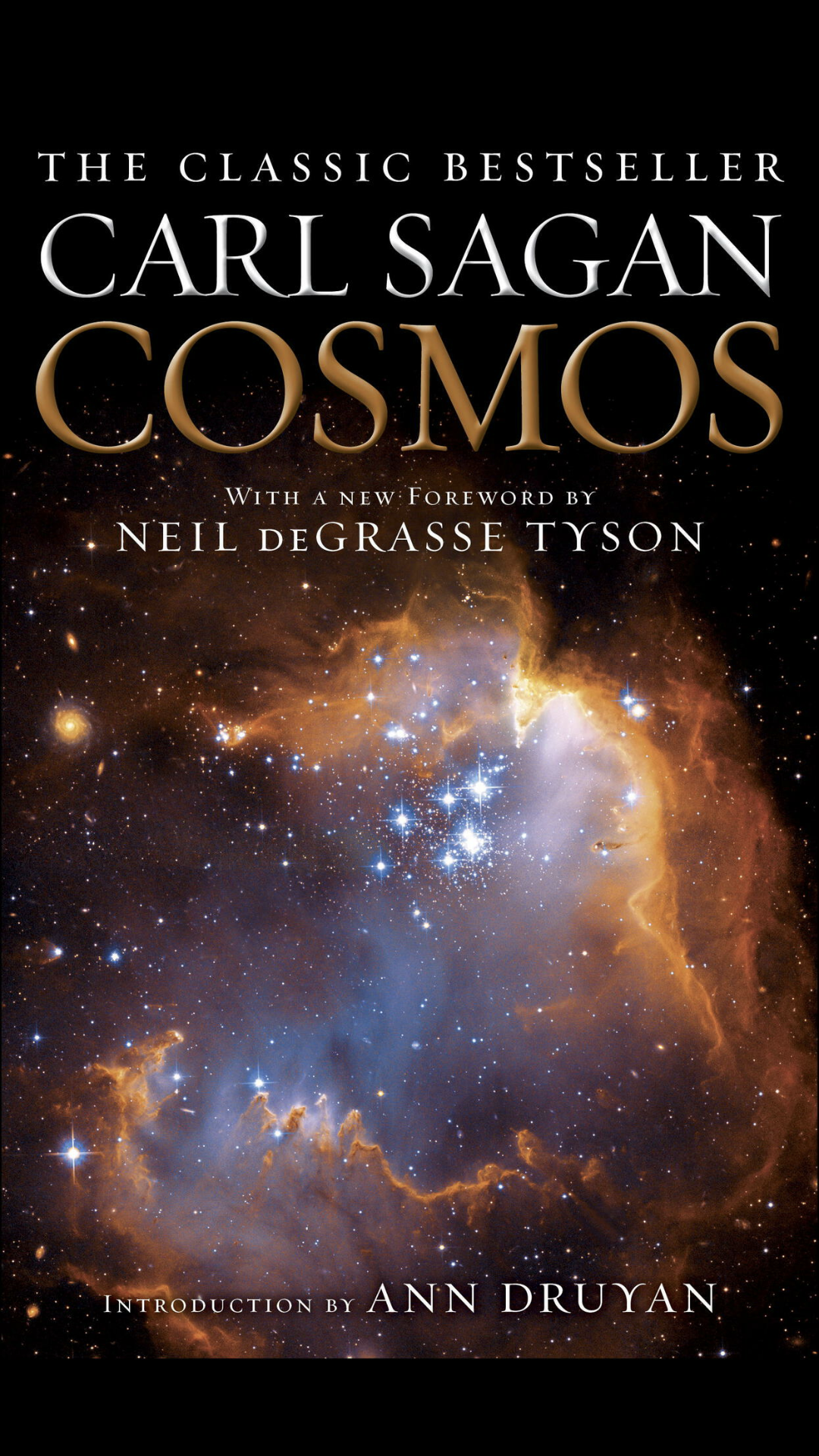
By now you’ve figured out that I really enjoy the work of science communicators. The teacher in me appreciates how some experts manage to explain complex subjects in a clear and accessible vocabulary. For a lot of people, the term science communicator is synonymous with Carl Sagan, who delighted the generation before mine with the massively popular mini-series called Cosmos : A Personal Voyage. The book was written conjointly and is meant to accompany the series. I have not seen the series, but if it’s anything like the book, it must be a delight.
The simplest one-celled organism is a far more complex machine than the finest pocket watch. And yet pocket watches do not spontaneously self-assemble, or evolve, in slow stages, on their own, from, say, grandfather clocks.
What does seventy million years mean to beings who live only one-millionth as long? We are like butterflies who flutter for a day and think it is forever.
What a marvelous cooperative arrangement—plants and animals each inhaling the other’s exhalations, a kind of planet-wide mutual mouth-to-stoma resuscitation, the entire elegant cycle powered by a star 150 million kilometers away.
Early on, you can tell Sagan is a great storyteller. The book is written in a conversational tone, as if he was explaining to you various concepts over a cup of coffee. You feel his delight over the possibilities brought on by scientific progress, his awe at the idea of extraterrestrial life as well as his disappointment when he mentions how short-sighted we are when it comes to the health of our environment. It feels like a personal book, which I guess is the point considering the title of the mini-series.
While the title and the general discourse around the book makes it sound like it’s focused on physics and astronomy, it’s actually much more than that. The author takes an historical approach to our scientific knowledge and our evolution as the unequivocal dominant species on the planet. The study of man, both a social and biological entity, is central to the theme of the book. It goes a long way into making our existence in this universe a very personal, intimate affair.
In a way, his approach reminds me of the Montessori pedagogy when it comes to education. We use a term called “cosmic education”, which sounds esoteric but could easily be translated as “universal” or “natural” education. In other words, we present the universe as a whole and highlight the interconnectedness of every single aspect of it. Carl Sagan says as much here :
Cosmos is a Greek word for the order of the universe. It is, in a way, the opposite of Chaos. It implies the deep interconnectedness of all things. It conveys awe for the intricate and subtle way in which the universe is put together.
The book is a love letter to scientific progress and a call to action for us. For the author, the application of scientific ideals is the way for humans to progress and thrive in harmony with the cosmos. It’s a beautiful sentiment that rang true in 1980 and it still is very much the case today.
Then we must educate our governments. We must learn the science and technology that provide the only conceivable tools for our survival. We must be willing to challenge courageously the conventional social, political, economic and religious wisdom. We must make every effort to understand that our fellow humans, all over the world, are human.
 I Read Many Things