Working with children, I get to hear a lot of questions. More importantly, I get asked a lot of questions I certainly don’t have the answer to, either because I just do not have the required knowledge, or simply because there is actually no answer. A good example I heard this year is “Was there something before the Big Bang?”
Asking and trying to answer those existential questions is one of the greatest things humans do. I absolutely love how we can conjure up the wildest possible explanations for stuff we don’t understand or can’t explain using our current database of knowledge.
Science and religion have the same roots, and still today they tackle some of the same questions: Where do we come from? Where do we go to? How much can we know?
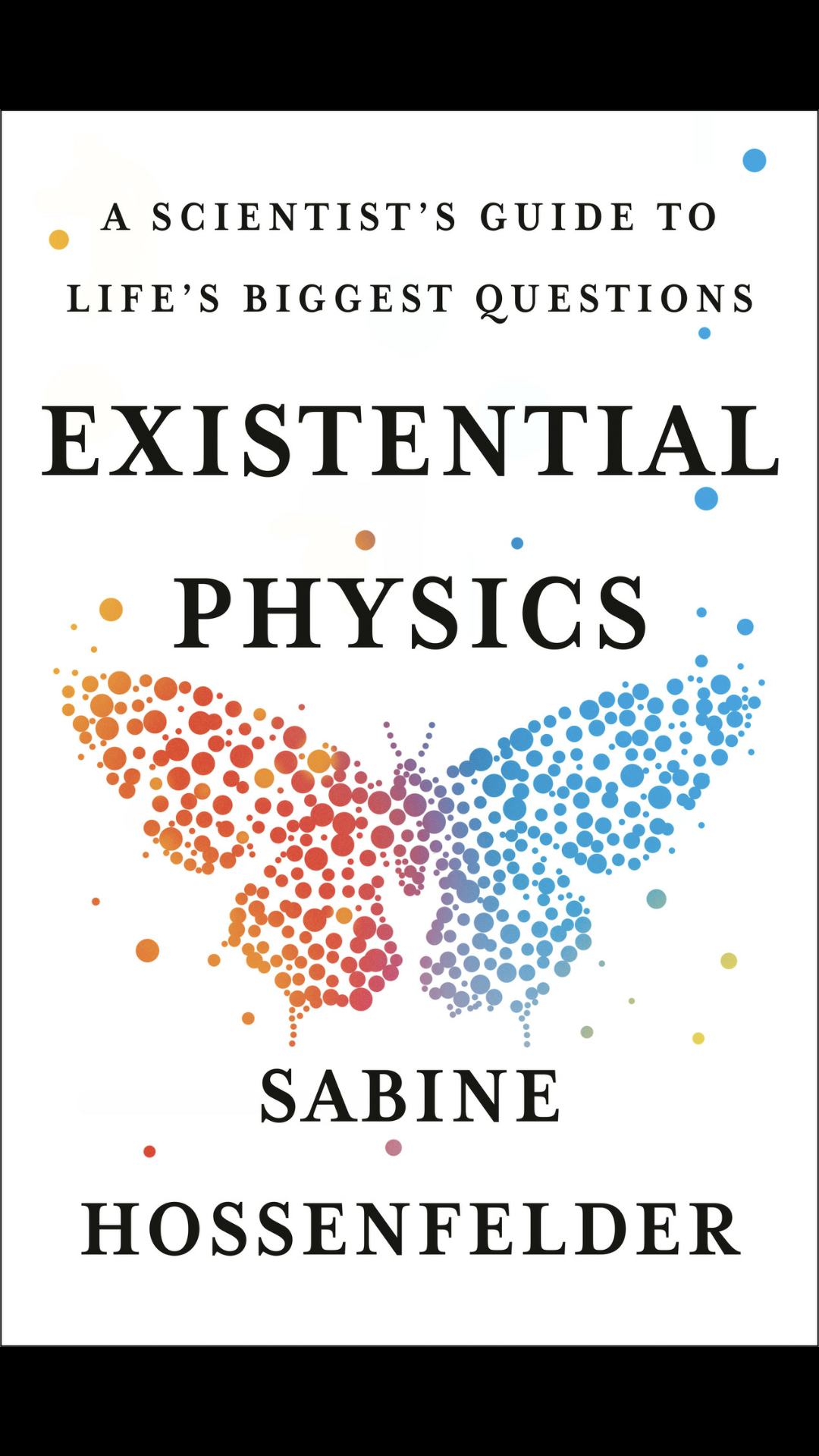
Sabine Hossenfelder is German theoretical physicist with a knack for communicating complex subjects for the layperson. She also has a channel on a certain video platform covering a variety of scientific subjects. In this book, she tackles some of the biggest questions humans are asking, and explores how we can try to answer them using physics – and especially quantum physics. She’s unapologetically scientific in her approach, but still manages to entertain some more spiritual ways of looking at certain things.
Each chapter corresponds to a major question (Does the past still exist? Why the universe came to be? How will it end? Why no ones gets younger? Does free will exist? Was the universe made for us? etc.), which obviously opens up a ton of questions related to the main one. The expression “to open a can of worms” is extremely apt for this book.
We don’t yet know exactly how to define consciousness, or exactly which brain functions are necessary for it, but it’s a property we observe exclusively in physical systems. Because, well, we observe only physical systems. If you think your own thoughts are an exception to this, try thinking without your brain. Good luck.
There are also four interviews interspersed between the chapters, each of them focusing on certain aspects of the questions that are being asked. She interviews experts in various subjects (maths, climate change, free will, the predictability of knowledge, consciousness, creating a universe) in order to go deeper.
If I had to pick my two favourite topics from the book – don’t get me wrong, they’re all interesting – it would be the first one about time and the one about the properties of atoms. Time is an absolutely fascinating concept. Just think for a second about what exactly is now. And what about the past? Does it ever stop existing? Say you look at a planet 56 light-years away. You actually look at the past of that planet, 56 years ago, so it still “exists” and will continue to exist at it “travels” through the universe. I’m certainly not explaining as well as the author, but it’s absolutely fascinating. Atoms are all made from the same subatomic particles – and are, in a way, indivisible – yet they all have different fundamental properties. Not only that, the same exact atoms, when merged in smaller or greater numbers, can have vastly different – emergent, this time – properties.
The behavior of large composite objects derives from the behavior of their constituents, but we have no idea why the laws of nature are that way.
It’s a great book that manages to make us appreciate how far science has come, how much we can actually understand. At the same time, it’s a honest look at the current limits of our knowledge.
Sometimes the only scientific answer we can give is “We don’t know.”
 I Read Many Things