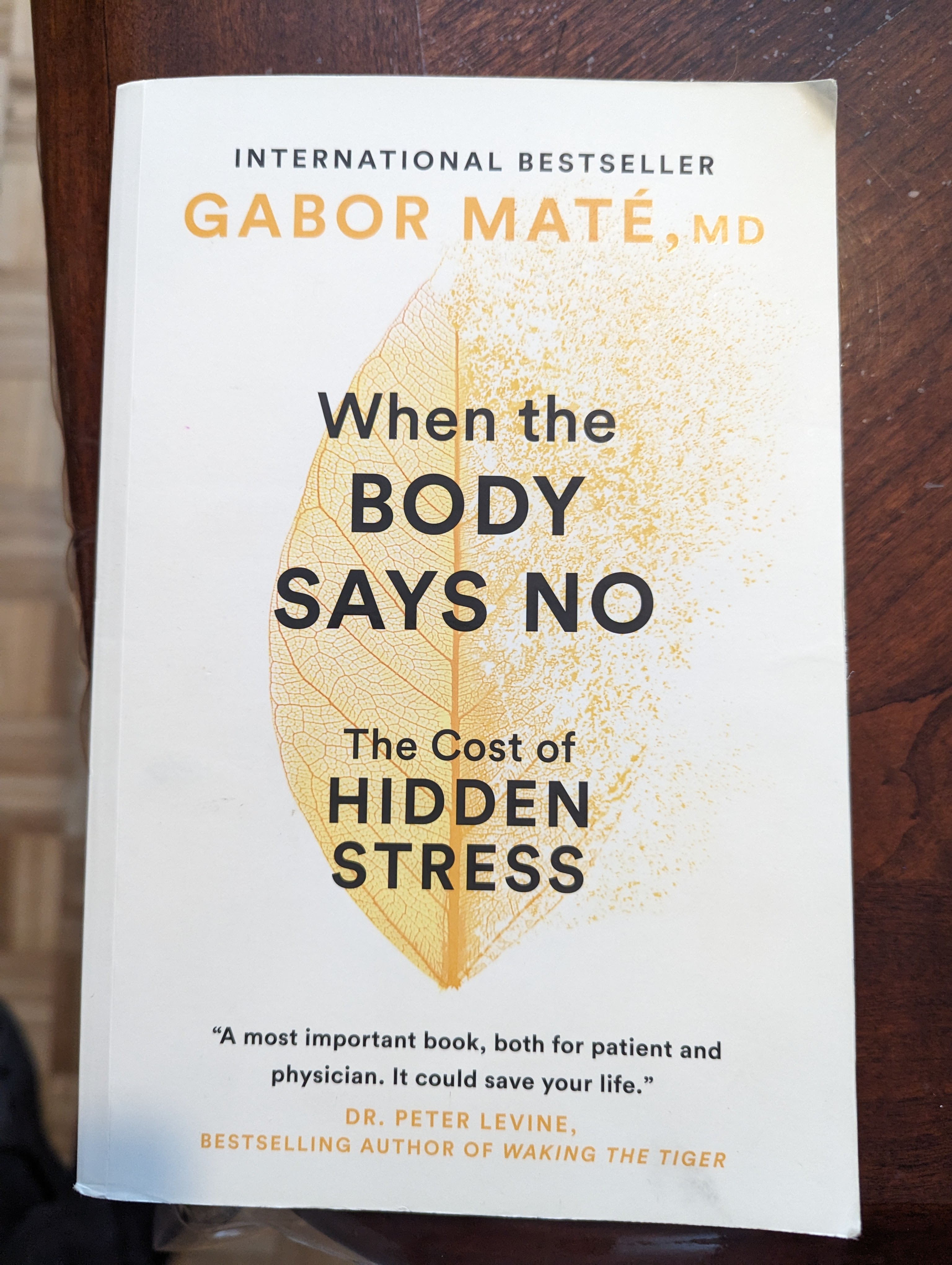
The very first article I wrote here was about Gabor Maté’s “Scattered Minds”, a fantastic book about ADHD. It’s the book that pushed me to go on this little blog project that I had been entertaining for a few months beforehand. Naturally, any other book written by the same author would catch my eye.
“When The Body Says No : The Cost of Hidden Stress” explores how stress affects the body on a physiological level. At the time, more than two decades ago, this wasn’t as widely believed or accepted as it is today. Using his vast experience as a physician, Dr Gabor Maté invokes multiple cases where he has witnessed the damaging effects of stress on his patients.
The research literature has identified three factors that universally lead to stress : uncertainty, the lack of information and the loss of control. All three are present in the lives of individuals with chronic illness.
One important distinction he makes at the beginning of the book is between nervous tension, a normal and momentary period where one feels stressed out by a set of circumstances, and underlying, constant stress that might not even be conscious. This last one is the real goal of the book, to identify what exactly can be the – often deep-seated – root of one’s problem, what it causes and how to address it.
There are a lot of different illnesses and diagnoses mentioned in this book ; GI problems, multiple sclerosis, scleroderma, ALS, Alzheimer’s, irritable bowel disorder and many different forms of cancer. In all of these cases, Dr Maté presents studies that have established a link between the psychological state of the patients and the illness itself. In some cases, the sample size is quite small and the evidence is therefore not as solid. In other cases, data abounds and the correlation is extremely strong. One can argue that the exact cause of any illness can be really hard to pin-point, and even harder to attribute to a single psychological reality. However, there is no denying that a multi-faceted approach is the way to go, and modern medicine generally agrees that you have to care for all aspects of a patient’s life in order to treat them.
Given the biochemical and neurological cross-influences within the PNI (psychoneuroimmunology) system, we can readily understand how emotions are able to interact with hormones, immune defences and the nervous system. In cancer causation, disturbed hormonal activity and impaired immune defences both play a role.
As far as Hidden Stress is concerned, the author explores multiple potential sources. Many of them revolve around the idea of repressed emotions, like anger or sadness that are lying deep within a person psyche. Constant and unresolved feelings of shame and guilt regarding certain situations can also play a major role. For others, it’s the inability to say “no”, often within the workspace, thus leading to a workaholic lifestyle. Some patients even refer to themselves as doormats, allowing everyone to take advantage of their otherworldly generosity. There are quite a few other examples in the book.
“In numerous studies of cancer, the most consistently identified risk factor is the inability to express emotion, particularly the feelings associated with anger. The repression of anger is not an abstract emotional trait that mysteriously leads to disease. It is a major risk factor because it increase physiological stress on the organism. It does not act alone but in conjunction with other risk factors that are likely to accompany it, such as hopelessness and lack of social support.”
One of the most interesting chapters in the book concerns the “Biology of Loss”, especially when it concerns loved ones like parents or spouses. Gabor Maté presents the parents as “biological regulators” for children, and if situations arise where they can’t fulfill that role, the development and maturation of the child’s brain can be negatively affected.
A physician can’t write a book like this without giving options on how to deal with stress. He ends the book with a quick tour through the seven As (Acceptance. Awareness. Anger. Autonomy. Attachment. Assertion. Affirmation.) as tools to help work through the causes of stress. Obviously, consulting a mental health specialist and finding the appropriate resources is incredibly important too.
I’m guessing this book was more though-provoking when it was released twenty years ago. Maybe it’s just the media I consume and/or my personal history of stress and anxiety, but a lot of what I’ve read in Dr Maté’s book did not surprise me. It reinforced what I already believed regarding the link between one’s psychological state and physical health. Nevertheless, it was a very interesting read and I recommend it to anyone interested in the effects of stress on us.
 I Read Many Things