
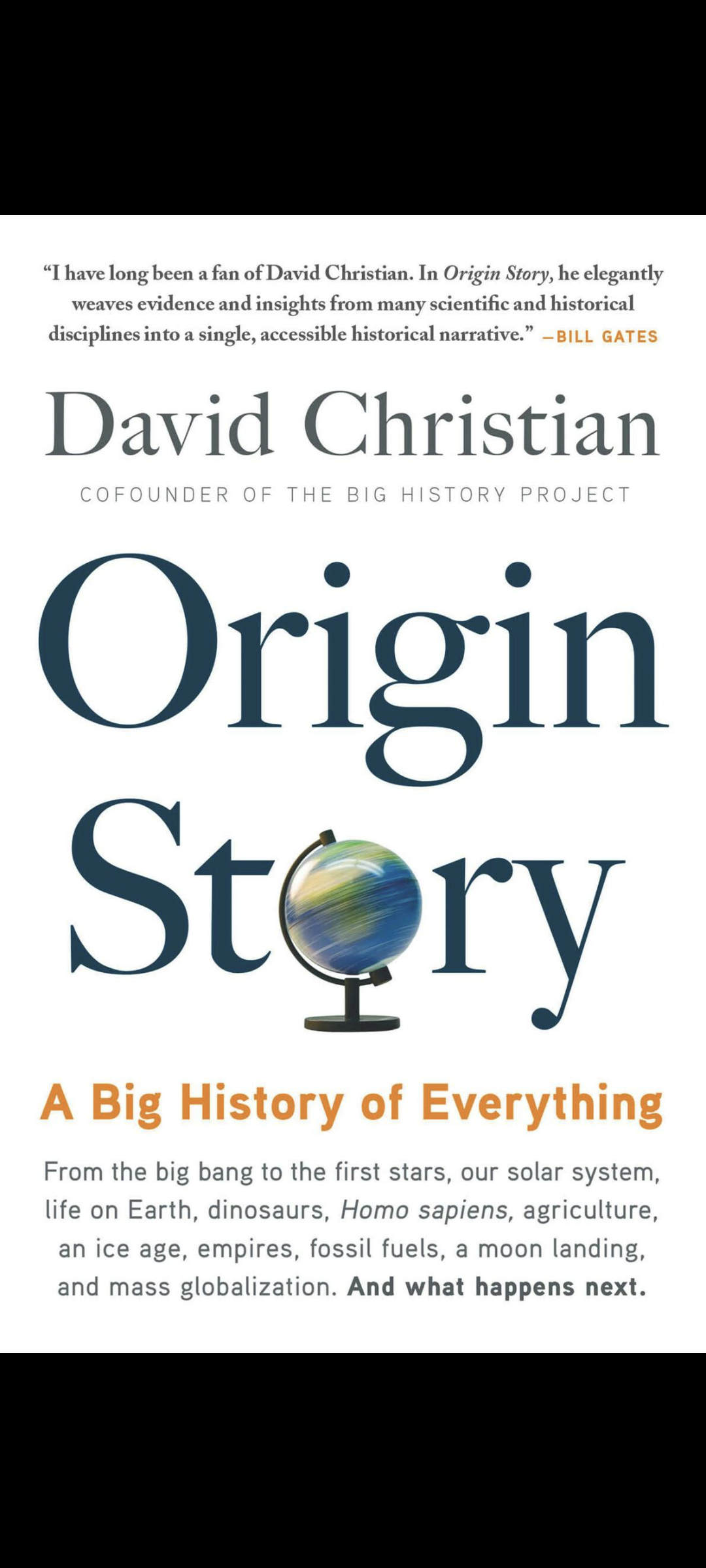
I was introduced to historian David Christian back when I was started my training to become a Montessori teacher, more than seven years ago. We watched his TED talk, as our trainer told us his approach to history was similar to what we promote in the Montessori pedagogy. Indeed, the author is a figurehead of what we call “Big History”, a way to study history that takes literally the largest possible view, starting from the Big Bang to today, and looking at far-reaching trends from a plethora of disciplines.
The title of the book, Origin Story, refers to the importance, for human groups, to share a common story, to feel connected on a higher level. Religions have long been excellent at that very purpose, uniting tribes, villages or whole states under common spiritual beliefs. While many religions still exist and thrive today, there is no question that the number of believers is declining, leaving a void of sorts. The discipline of Big History tries to remedy that, by giving all of mankind a view of our global origin story. Again, this is not unlike the Montessori approach to teaching children, what we teachers call “cosmic education”. In fact, Maria Montessori herself has said : “Since it has been seen to be necessary to give so much to the child, let us give him a vision of the whole universe.” I think David Christian and her would get along quite nicely on the subject of history.
We are rarely encouraged to assemble that knowledge into a single, coherent story in the way that globes in old-fashioned classrooms linked thousands of local maps into a single map of the world. And that leaves us with a fragmented understanding of both reality and the human community to which we all belong.
The chapters of the book, for the most part, represent different thresholds, major steps in our common origin story. A threshold also means a significant increase in complexity. That will make more sense as we go along. The first part of the book is physics-heavy, defining what happened before a concept as complex as life was even considered. First, the big bang model, the beginning, as far as we know, of everything that makes up our universe and the laws governing it. The second threshold is what happened after, as the matter in the universe started gathering and forming stars and galaxies and new elements. In the same vein, the third chapter is all about increasing complexity, both in a very large scale (planetary systems and different planets altogether) and in the microscopic realm (atoms coming together to form molecules).
It’s as if entropy demands more energy from an entity if it tries to get more complex; more complex things have to find and manage larger and more elaborate flows of free energy. No wonder it’s harder to make and maintain more complex things, and no wonder they usually break down faster than simpler things. This is an idea that runs right through the modern origin story and has a lot to tell us about modern human societies.
But all planetary bodies are cooler than stars, and chemically richer and more diverse, and that’s why they provided Goldilocks conditions that allowed the building of new forms of complexity. Eventually, at least one of these objects, and probably many more, generated life.
The second part hones in on the coming of life on Earth, and what it really means. If the first part was the realm of physics, this one is all about chemistry and geology. One important idea that will come back time and time again starting here is the Goldilocks conditions, the perfect set of circumstances for certain things to happen, like in this case, the apparition of Life. It’s all about how these conditions changed and evolved on Earth as the Biosphere interacted with the other spheres (atmosphere, lithosphere & hydrosphere). Life if not simply adapting the conditions, it’s an active participant. “Big Life” appears about 500 million years ago and its reign is punctuated by experiments made by organisms to adapt and problem-solve through extinctions and changes in global climate.
Complex adaptive systems can survive only in very specific environments, so they need to be able to read or decode local information as well as the universal rules. And that’s new.
Today we are learning that we can’t make sense of the biosphere’s recent history without understanding the much longer era of little life. As they evolved, prokaryotes developed many new tricks that let them exploit different environments, and we still use several of the biochemical techniques they pioneered.
We eventually arrive at the sixth threshold, the arrival or humans on Earth. From first primates to hominins to Homo Sapiens. There is quite a lot of information there, but what truly sets this creature apart is language, the ability to transmit and accumulate information over generations. Humans also start to change on Earth on a much deeper level than any other species before. Threshold 7, agriculture, accelerated that process significantly. It started a feedback loop of production and population, leading to a great number of consequences (diseases, lack of nutritional variety, lower life expectancy, etc.) and new challenges, many of which were unforeseen. Eventually, this led to the birth of larger settlements, cities and even states, paving the way for the first “urban” civilizations and empires. It led to specializations of all kinds and the advent of highly hierarchical power structures (both administrative and religious). This was a whole new level of complexity. Writing also came around at that time. The end of the Middle-Ages brought about expansion and colonization, therefore breaching the distinct geographical and cultural zones of our planet. Migration became more prominent, and so was the flow of information, leading to a scientific and commercial revolution. Then, fossil fuels came around and led to threshold 8, the Anthropocene, the unequivocal domination of humans over our planet. The pace of progress picked up yet again as innovation upon innovation changed how we live.
Whatever happened, our species seems to have been the first to cross the linguistic threshold beyond which information can accumulate within communities and across generations.
Surplus people, surplus food, surplus goods, and surplus energy represented new forms of wealth, which raised the question: Who was going to control (and enjoy) this wealth? Over time, surplus wealth would be mobilized by small but powerful minorities, and the structures they built to mobilize surplus wealth, often using crude forms of coercion, would form the muscles and sinews of agrarian civilizations.
All of this leads us humans to wonder (and worry?) about the future. Predictions models abound and give us a glimpse into the near future, where challenges seem countless and worrying (climate change, artificial intelligence, income inequality, unfettered economical growth, etc.). The idea the author puts forward is a mature Anthropocene, where science and innovation bring about positive changes and help stabilize our world.
The challenge we face as a species is pretty clear. Can we preserve the best of the Good Anthropocene and avoid the dangers of the Bad Anthropocene? Can we distribute the Anthropocene bonanza of energy and resources more equitably to avoid catastrophic conflicts? And can we, like the first living organisms, learn how to use gentler and smaller flows of resources to do so? Can we find global equivalents of the delicate proton pumps used to power all living cells today? Or will we keep depending on flows of energy and resources so huge that they will eventually shake apart the fantastically complex societies we have built in the past two hundred years?
This is truly a massive book, not because it is particularly long (around 340 pages) or complex, but because it tackles a massive subject and tries to put our history in a much larger context. I enjoyed the first half more than the second half, maybe because it was closer to our Montessori view of history, before humans came around. I still loved his approach to humans, focused on changes and large-scale realities instead of the typical important dates, wars, kings and empires we had to remember in school.
His style is engaging and honestly quite easy to follow. That’s quite the achievement, given the task he’d given himself. In those three hundred pages, you’ll learn about physics, astrophysics, chemistry, geology, economics, biology, politics, linguistics, philosophy, sociology, ecology and basically every other field of study ever conceived by humans. If you’ve ever felt history was boring when you were in school, this book is proof that the discipline has quite a lot more to offer. If you’re uncertain, go watch the video I’ve linked above, it’s a good place to start to see whether or not the idea of Big History suits you.
 I Read Many Things