While there is a seemingly infinite number of issues facing education at the present, I would argue none is more pressing than equipping this young generation with the necessary critical thinking skills to navigate the world. At this point, it’s annoyingly cliché to point out the over-abundance of information circulating on the Internet, and resorting to bashing the young generations (millenials, gen Z or Gen Alpha) doesn’t help anyone. What helps is developing the tools to become a useful member of society.
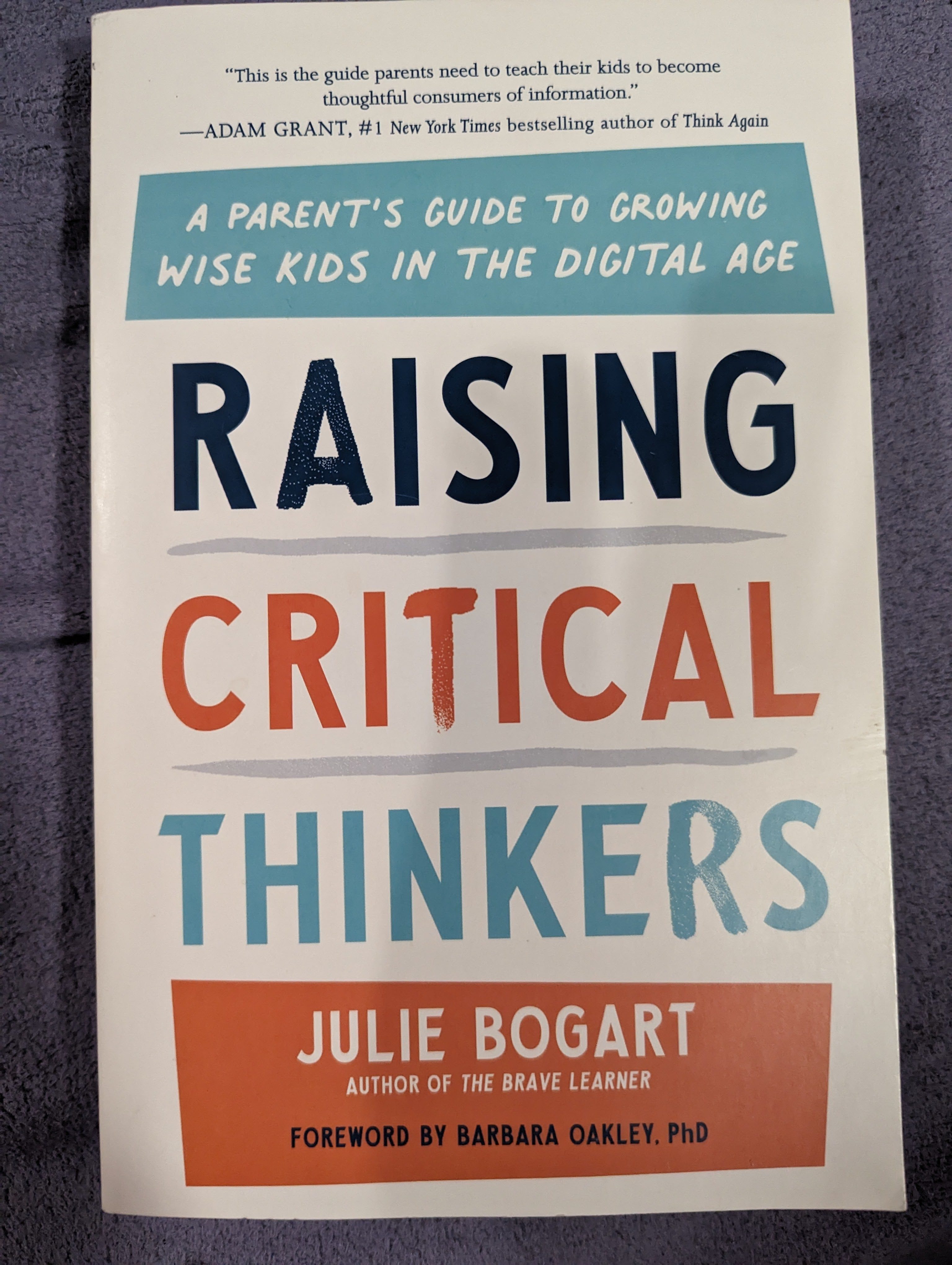
With Raising Critical Thinkers, author Julie Bogart looks at critical thinking, its various aspects, why it’s so important and how to develop it. It’s a book clearly aimed at parents and educators, which is perfect for me since I am both. For each chapter, we get the theory and a few pages on how to put into practice what has been discussed.
The book is split into three parts, and first we try to get a better sense of what exactly is critical thinking. How can we evaluate a source? What exactly is the difference between facts, interpretations and opinions? What is the role of education in this realm in regards to evaluating these various aspects? The fifth chapter of the book, the one about caring, spoke immensely to me. How we assign value to parts of learning, namely accuracy and credibility. The sixth is just as important, focusing on our own identity (personal or community-driven, reason or perception) and how it informs our worldview.
Education is not a walk through neutral information, mastered for a test. It’s the ability to identify the storytellers, to evaluate sources, to question perspectives, and to determine the usefulness of a viewpoint at a particular moment in time. In fact, interpretations of historical events, literature, scientific discoveries, and more shift generation to generation, year to year, sometimes within months.
The second part is about the three main strategies we can use and teach to build up these critical thinking skills : read, experience, encounter. Reading helps exploring a subject while maintaining a certain distance from the subject. It gives an opportunity to expand one’s horizons with different genres and viewpoints. The author presents reading as a active hobby, and not merely a passive one, require attention and focus. It’s both a skill and a habit. Experience is quite straightforward, it’s basically the Montessori ideal of “learning through doing”. As she points out, kids are naturally driven to the “applied” part of learning, they love to get involved and try stuff out. Encounter is coming face to face with the “unknown”, with a situation or a person that will likely put you out of your comfort zone and require you to appreciate a different point of view than your own.
The quickest way to provoke new thinking is to encounter difference directly. When you help your kids navigate complexity and difference, you them how to grow their capacity to participate in a world populated with variety. The better they are able to greet difference (which is not the same as agreeing with it), the more skillful their thinking will become.
The third and final part of the book is all about self-awareness, a massively important ability to develop in order to truly grasp our own thinking. How do we react when confronted to an opposite point of view? We all look at what happens from our own reference frame, coloured by our loyalties and biases, not unlike sports fans. Chapter twelve is, according to the author, the apex of the book, the culmination of everything we’ve seen until now : Interpretation. As she points out, in everything we interpret, we have to be dutifully aware of one thing. Well, not a single thing, but the all-encompassing idea of context. Whereas the Internet is known as the place where “content is king”, here we can say that “context is king”. For any piece of work (movie, article, book, series, news report, etc.), context matters a lot. A good way to grasp that is to look at classic works of literature, which are impossible to truly appreciate without placing them in their proper historical and cultural context. Finally, the author talks about the immense power of changing one’s mind. It does sound painfully obvious written out like this. In a way, it truly is. We do it our whole lives, just by getting older, without realizing it. Even
I was already sold on the idea before I bought the book, so it’s not really surprising that I enjoyed it. In a way, we could say that the author was preaching to the choir. It leans heavily into the practical aspects, and doesn’t feel the need to delve deeply into the theory of how and why critical thinking can be a hard goal to achieve on a fundamental, psychological level. It’s clearly aimed at a layperson, and not an expert on the subject. And it achieves this job wonderfully by being relatively short (a tad under 300 pages, including the multiple examples on how to implement such lessons in a classroom or at home) and to the point. If you work with children in any capacity, it’s definitely worth it.
 I Read Many Things