
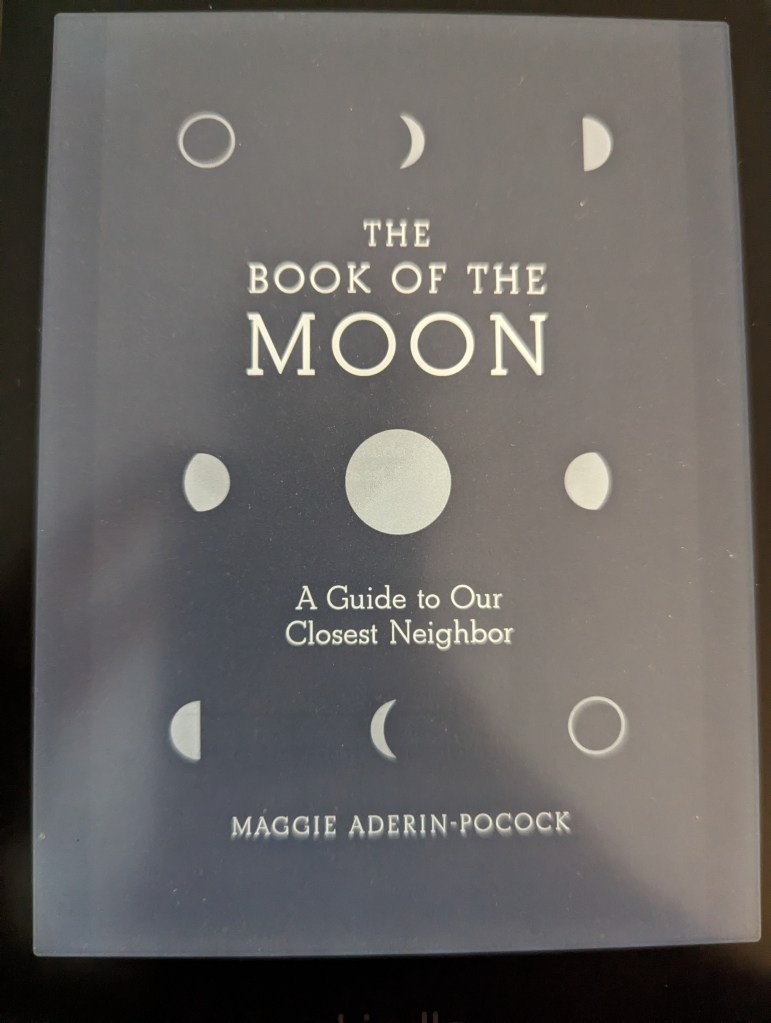
By now, anyone who knows me even a little understands that I have a deep passion for most sciences, especially physics and astronomy in the past couple of years. It seems like every time I come across a science book that looks remotely interesting, I’ll be tempted. And now it’s much worse since I have an e-reader and receive daily e-mails concerning numerous deals. I am falling prey to the algorithms…
In any case, here’s a book about the Moon that I just read! The author is a self-proclaimed Moon enthusiast who also happens to be a trained science educator in the UK. She became enamoured with our natural satellite when she was a child and this passion has led her to pursue higher education in the field. If you take into account the fact that she’s a woman from African descent – a historically rare occurrence in science – it’s pretty awesome what she does represent to this upcoming generation of scientists.
The book itself reads like a diary, written by someone sharing their passion for a subject near and dear to their heart. As such, the author is using accessible, easy-to-understand vocabulary. The relatively rare technical terms are aptly explained. As is the case when someone can explain complex concepts with simple words, you can feel she really knows what she’s talking about.
The first part of the book is named “Moon 101”, basically a crash course about the basic facts and features of our spatial neighbour. Its size and weight, its magnetic and gravitational fields, the temperature, the seasons, its gravitational field, how it was formed, etc. Nothing exactly new.
Next, she focuses on how the moon has influenced various societies during human history. For some, it had a practical application – such as calendars – and for others, it was a source of spiritual and/or emotional inspiration. As we know, some societies had gods or spirits associated with the moon. It has sparked wonder for millennia. From my point of view, this part of the book felt out of place and not nearly as interesting as the other parts.
In the following chapter, we learn the actual physical consequences of the moon’s presence on our planet. We all know about the tides, but recent studies have shown that the impact of tides might have been much more important millions of years ago. Since the moon was significantly closer to the Earth when it was formed, the tides were more pronounced and more land areas across the globes were constantly flooded, then dried by the sun’s heat. Some think this might have created the ideal conditions for life to appear. I had never heard of this theory before, and thought it was quite interesting.
There is a short chapter on moon observation ; how it has evolved through the years and what are the best ways to get into this hobby.
You can’t really write about the moon without mentioning humanity’s drive to explore and push boundaries. Her last chapter is about the space race, both from an historical standpoint and the more recent push driven by emerging world powers – China and India, mainly – and private companies like SpaceX. She believes the future of moon exploration will be driven mostly by the commercial sector, which is a somewhat unusual stance coming from a scientist.
While I really loved her enthusiasm and how well she can explain certain subjects in a very accessible manner, I was baffled by how she chose to order the chapters. Even as I was writing this article, it felt off having those topics in that sequence. Ultimately it doesn’t matter all that much, as the content is mostly interesting – save for that one chapter I mentioned earlier. It might only be me feeling that way. In any case, it’s a good book, and would be a nice read for someone who is just getting interested in science and astronomy.
 I Read Many Things