
Geography is somewhat of a weird subject. It’s not exactly what you would consider “hard” science, like chemistry or physics, and yet I think it would be wrong to call it a purely social science. It straddles the line between both because it’s such an all-encompassing field. When you describe the chemical composition of our planet, the core, the mantle and the crust, it’s part of geography. When you talk about about how maps are drawn with the North up, it’s geography. When you describe the European Union, you’re still in the same field. And I know, because I took many such courses during my college years, that even within the field, you’re bound to find a ton of disagreements about what exactly is geography.
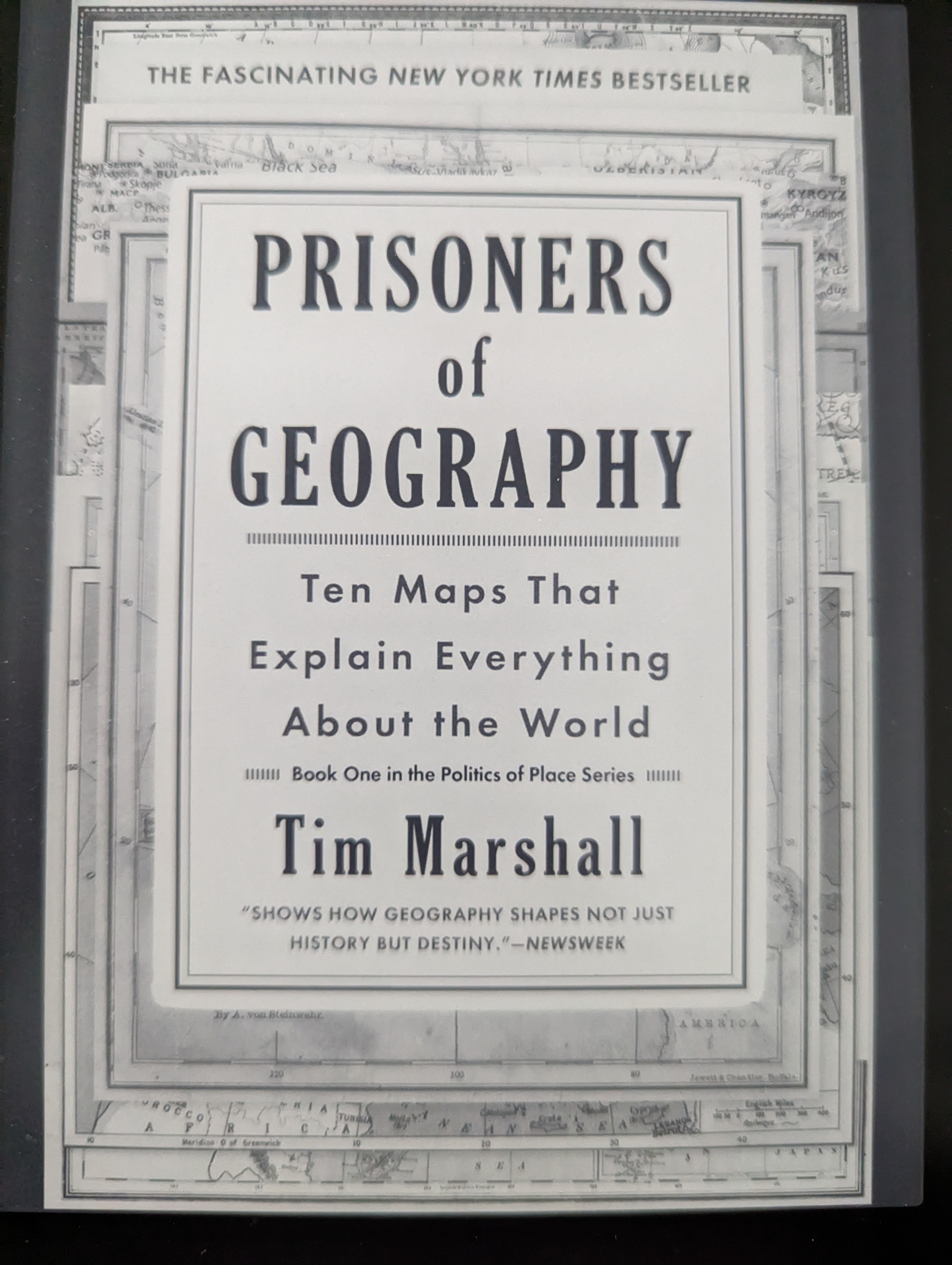
That’s actually not a terrible introduction to this book by Tim Marshall. The premise looks very promising from a purely geographical standpoint, analyzing how geography has affected and still affects the reality of so many countries and regions around the world. It can be politically, economically, militarily, socially or any combination of these. The author travels around the world, looking at the various, and sometimes very obvious, places around the globe where the particular geographical features are playing such a role.
Overall there is no one geographical factor that is more important than any other. Mountains are no more important than deserts, nor rivers than jungles. In different parts of the planet different geographical features are among the dominant factors in determining what people can and cannot do.
Most of the places he takes us to are rather obvious, like Russia, the Middle-East or the Indian subcontinent. Some others feel a little vague, like those chapters simply named “Africa” and “Europe”. I understand why they are taken as single entities, but it still feels a bit out of place, especially since Africa is a huge and incredibly diverse continent in terms of geographical characteristics.
To help you get an understanding of what the author means by geographical features influencing a country’s decision, I’ll give a few examples from the book.
Starting with Russia, it’s no secret that giant Eurasian bear has been making moves for the past few decades. As the biggest country on earth by a ridiculously wide margin, it’s both very hard to defend and very hard to invade, as history has proven. It’s also a country with no warm-water port for its importations and exportation. Furthermore, it’s surrounded to the west by the strongest military alliance on Earth, NATO, and its allies. It’s easy to see why Russia’s particular geography has put it in a particular spot and “explains” its actions.
The USA, on the other hand, has so many positive features that have helped them become a powerful force on the global stage. It has a very diverse and rich geography in terms of natural resources, it has access to three oceans, it was sheltered from the vast majority of global conflicts, including both world wars, by the simple presence of the Atlantic ocean. In short, they had many of the right ingredients to build a superpower, and they did.
Europe has a lot of flat lands, easily navigable rivers, a very good climate due to the Gulf Stream, arable soils to the west and access to the commerce-friendly Mediterranean Sea. France has probably the best location of any, which explains its status as a world power for most of our era. Africa is humongous, but its rivers are tough to navigate and the borders were drawn by European powers, leading the artificially formed countries to suffer conflict after conflict. I’m simplifying but you get the general idea. The Arctic is an immense chessboard that will open up slowly over the next few decades as global warming takes its toll. It’s fair to say it’ll be front and center to many great powers’ ambitions in the twenty-first century.
The melting of the ice changes the geography and the stakes. The Arctic states and the giant energy firms now have decisions to make about how they deal with these changes and how much attention they pay to the environment and the peoples of the Arctic.
Asia is the continent that gets the most attention, due to it being so vast, containing more than half the world population and so much different cultures and histories. Four of the ten chapters are about Asian maps (five if you include Russia), and it’s not surprising. The challenges facing its peoples are incredibly complex – in every conceivable way – and it’s impossible to go into every detail in a simple book, let alone in a short article like this one.
In some cases, the author veers very far from the geography to delve deeply into history, politics and economy, to the point where there’s almost no link between what he’s writing about the geography of the area itself. It’s certainly not a deal-breaker nor is it uninteresting, but part of me really wanted to focus on the challenges or issues posed by specific geography. I would have also liked more specific examples or maybe less obvious ones. Africa is thirty million square kilometers, has a population of one and half billion and has over fifty countries. Surely there is enough meat here for more than a single chapter.
I still really enjoyed the book for the most part. I’m a bit of a geography geek so there was a lot I knew already, but the book still managed to teach me a few things and/or make me look at certain situations from a new angle. Anyone who is interested in global politics and international events will certainly find something to enjoy and to learn from this book.
Of course, geography does not dictate the course of all events. Great ideas and great leaders are part of the push and pull of history. But they must all operate within the confines of geography.
 I Read Many Things