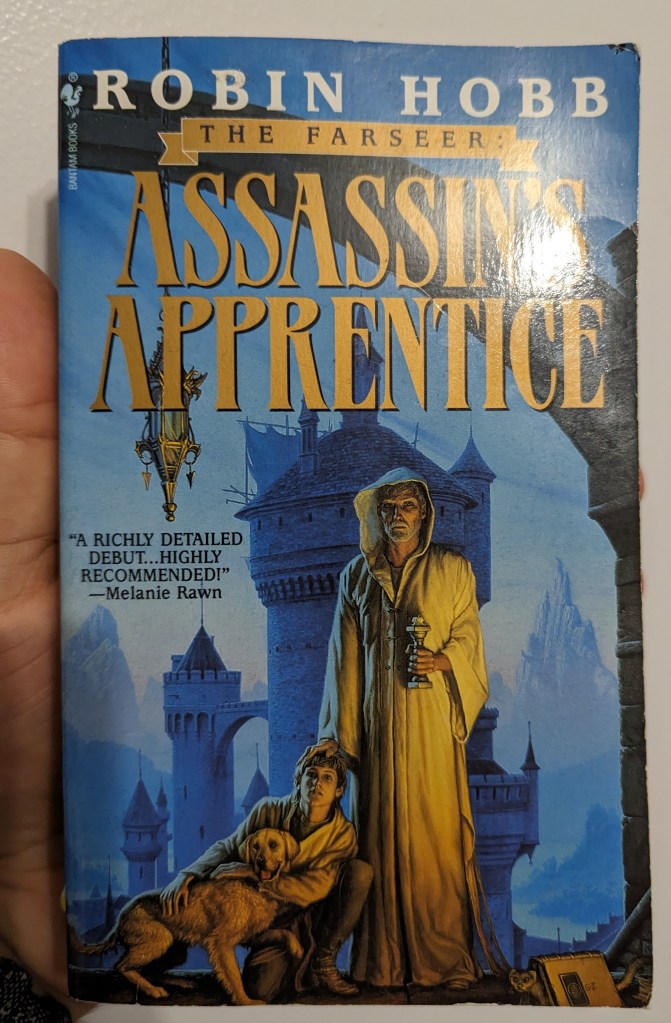
I’ve heard the name Robin Hobb quite a few times years ago when I was working in a bookstore. This author is evidently well-known amongst Fantasy readers for her numerous works. My personal experience with fantasy is mostly through the Tolkien legendarium and the Witcher series of books and games. For a while now I thought I should expand my horizons a little and found a bunch of Robin Hobb books in a used books store and decided to start with her first trilogy, Farseer, starting with Assassin’s Apprentice.
The story revolves around a young boy named Fitz. He is the illegitimate child of the prince Chivalry, next in line to become king of the Six Duchies. At the young age of six, he is taken back to the castle where the stablemaster – Burrich – takes him under his wing. Over the coming years, he catches his grandfather’s – the king – eye and is trained in secret to become an assassin working in the shadows for the kingdom.
In the background, the kingdom is put under tremendous stress from an outside threat, the Red-Ship Raiders. At the same time, there is some sort of strife taking place between the different duchies, namely those who are near to the sea – the Coastal Duchies – and the ones inland – the Inland Duchies.
One aspect I think will be developed further as the series progresses is the Skill. This is name given to a magical ability allowing the practitioner to communicate telepathically over great distances. Fitz is actually learning to use it for a couple of chapters but it never fully manifests for him. The way it’s talked about by different characters makes me believe it will be an important plot device in the following books. There also seems to be other supernatural abilities in this world, namely the Wit, a talent that Fitz has to communicate with other living beings. In this book, it happens mostly with the dogs the young boy takes care of. Here too I’m guessing this will become even more important as he gets older.
I had a bit of trouble getting into the story at first, at least for the first half or so. It’s a slow-moving plot and the author spends quite a bit of time developing the characters and their relationships. This ends up being one of the book’s main strengths (more on that later). The action is sporadic at best, and even the most intense moments last for a couple of pages at most. I might be influenced by the fact I know it’s a trilogy, but the book felt like a very, very long introduction for at least two hundred pages.
Another – admittedly weird – thing that bothered me is the writing. It’s so small and there is almost no margins on the pages. It’s like blocks of texts and feels a tad overwhelming. The one I got (from a thrift store) is an old edition, from the mid-nineties, so maybe newer editions have a more reader-friendly presentation.
As I stated, the strength lies into the characters, who are fleshed out to a rather impressive extent. They do have some of the silliest names you can imagine – the king is called Shrewd, and the princes Chivalry, Verity and Regal – but at least there is a valid in-world explanation to these names. The main character is honestly one of the most complex I’ve come across, and there is probably more to come in the following installments. Even if the book feels like a long introduction, it sets the table quite nicely for a lot of intrigue. In fact, very little is actually resolved at the end of the book. Clearly, the author had already planned that there would be much more to come.
And since I’ve bought the trilogy already, I’ll be there to continue reading about Fitz and the kingdom of the Six Duchies. Not that I was exactly blown away by this one, but it’s intriguing enough that I’m curious to see where it goes.
 I Read Many Things