
I first discovered Simon Singh while watching videos on one of my favourite channels, Numberphile. As a physicist with a real love for mathematics, he spoke with eloquence and simplicity about Fermat’s Last Theorem and the omnipresence of maths in The Simpsons and Futurama. In fact, the first book written by him that I’ve read is The Simpsons and their Mathematical Secrets. It’s a fun read and quite revealing, since I’m fairly sure the average TV viewer didn’t know that many of the writers and producers are actually mathematicians. I also read earlier this year his book on Fermat’s Last Theorem, Fermat’s Enigma. In short, he’s a very talented writer and story teller who makes complex ideas much easier to grasp for the layperson.
The Code Book continues in that vein, tackling the very old human problem of communicating an information to someone without being overheard by a third party. While we often use the word code, like he does with the name of the book for the general audience, it would be more accurate to use the term cryptography. Which is what he actually does in the book.
At first, he explains the different types of codes, the different strategies used to hide a message, their strengths and their weaknesses. At the same time, he gives many historical examples of leaders and experts and how they manage to create code or decipher them. For the most part, it’s set in chronological order, starting in Antiquity and the Middle-Ages.
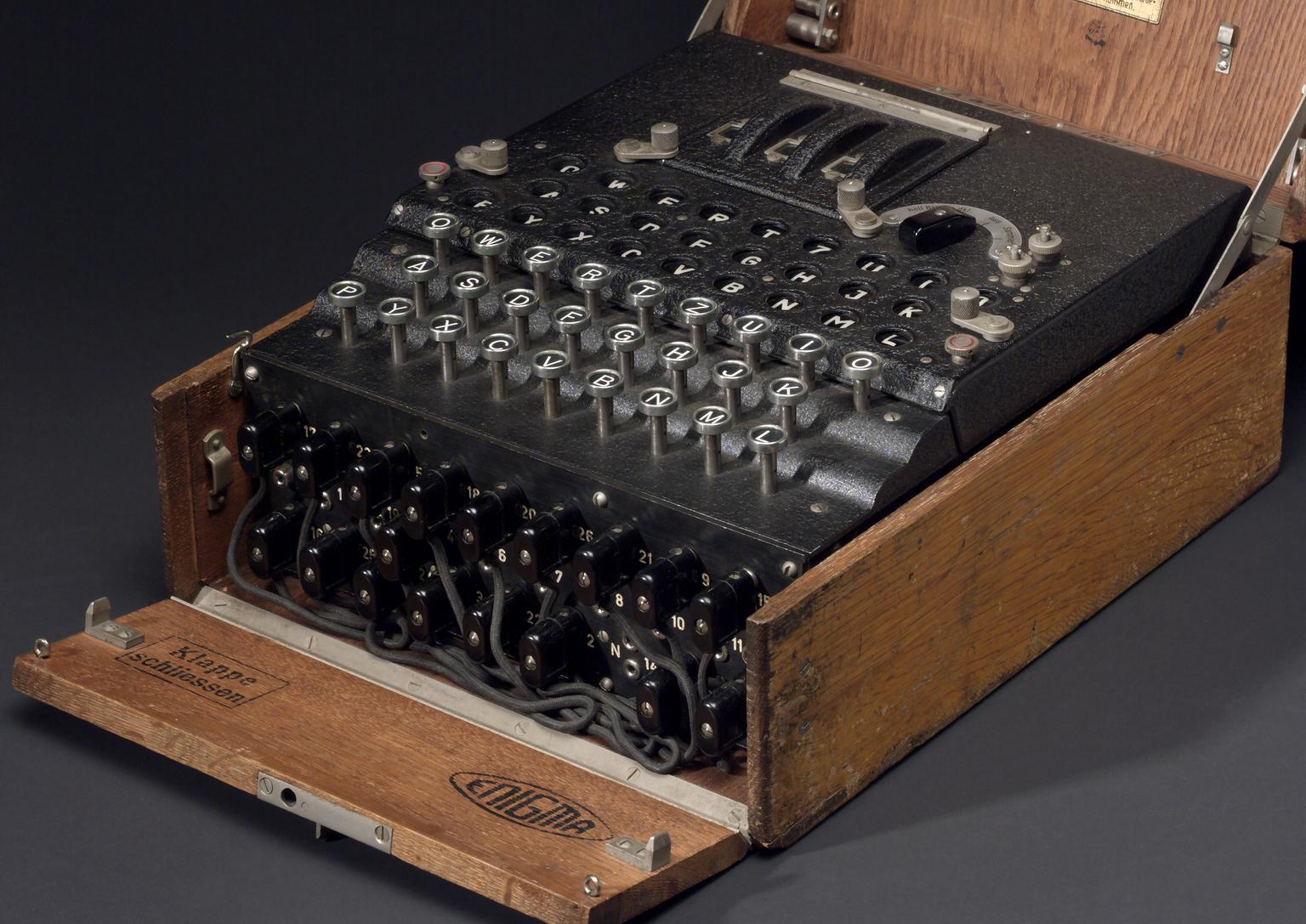
The second part of the book, covering three chapters, is about the Enigma machine, inarguably the most famous cipher device in history. I’d already learned quite a bit about the story of this machine, mostly from maths or science channels on YouTube. In short, Enigma is the machine used by the Germans in the first World War to send military orders and tactics to troops across Europe. It was a piece of engineering genius. Then, as the second World War started, they used a souped up version of Enigma, which had 159 quintillions (that’s eighteen zeroes) possible initial settings. Unsurprisingly, it was thought to be unbreakable. But as with every code in history up to that point, it was eventually broken by collaborating experts from Poland, France and England. The most well-known of them being the British team of experts, led by mathematician Alan Turing. If you’re interested, you can also watch The Imitation Game with Benedict Cumberbatch playing the role of Turing. It’s excellent!
In the next part, the author reminds us that code-breaking is not always about uncovering something that’s meant to be hidden. It can also be about discovering our past. Here, he talks about two famous examples of long-lost written languages that have been decoded by experts, namely hieroglyphics and Linear B, an ancestor of the Greek language.
The latter chapters mostly concern modern applications of cryptography. Here you’ll find the history of the Morse code and ASCII, among others. Then, in the computer and information age, the importance of cryptography to ensure security. In the same vein, he writes about the eternal struggle of privacy as far as individuals, private companies and the government go. ” It’s a very interesting debate that is still very much in the zeitgeist of our era. The last chapter is about the future of computers and, at the same time, the future of information and encryption of that information. Quantum computing is still in its infancy and purely theoretical. He explains what would likely happen if it became a reality. In short, it would radically change everything in our world that’s become heavily reliant on computers.
Cryptography used to be an obscure science, of little relevance to everyday life. Historically, it always had a special role in military and diplomatic communications. But in the Information Age, cryptography is about political power, and in particular, about the power relationship between a government and its people. It is about the right to privacy, freedom of speech, freedom of political association, freedom of the press, freedom from unreasonable search and seizure, freedom to be left alone.
It’s a very information heavy book, clocking at over 500 pages. As I mentioned earlier, it’s very well-written and stays engaging throughout. Obviously it really helps if you have some prior knowledge in mathematics or science, especially in the last few chapters. Great book, I recommend it!
 I Read Many Things